AZ-500 Is Retiring: What Happens Next?
What AZ-500 retirement on August 31, 2026 means for active certifications, renewals, and the SC-500 transition.
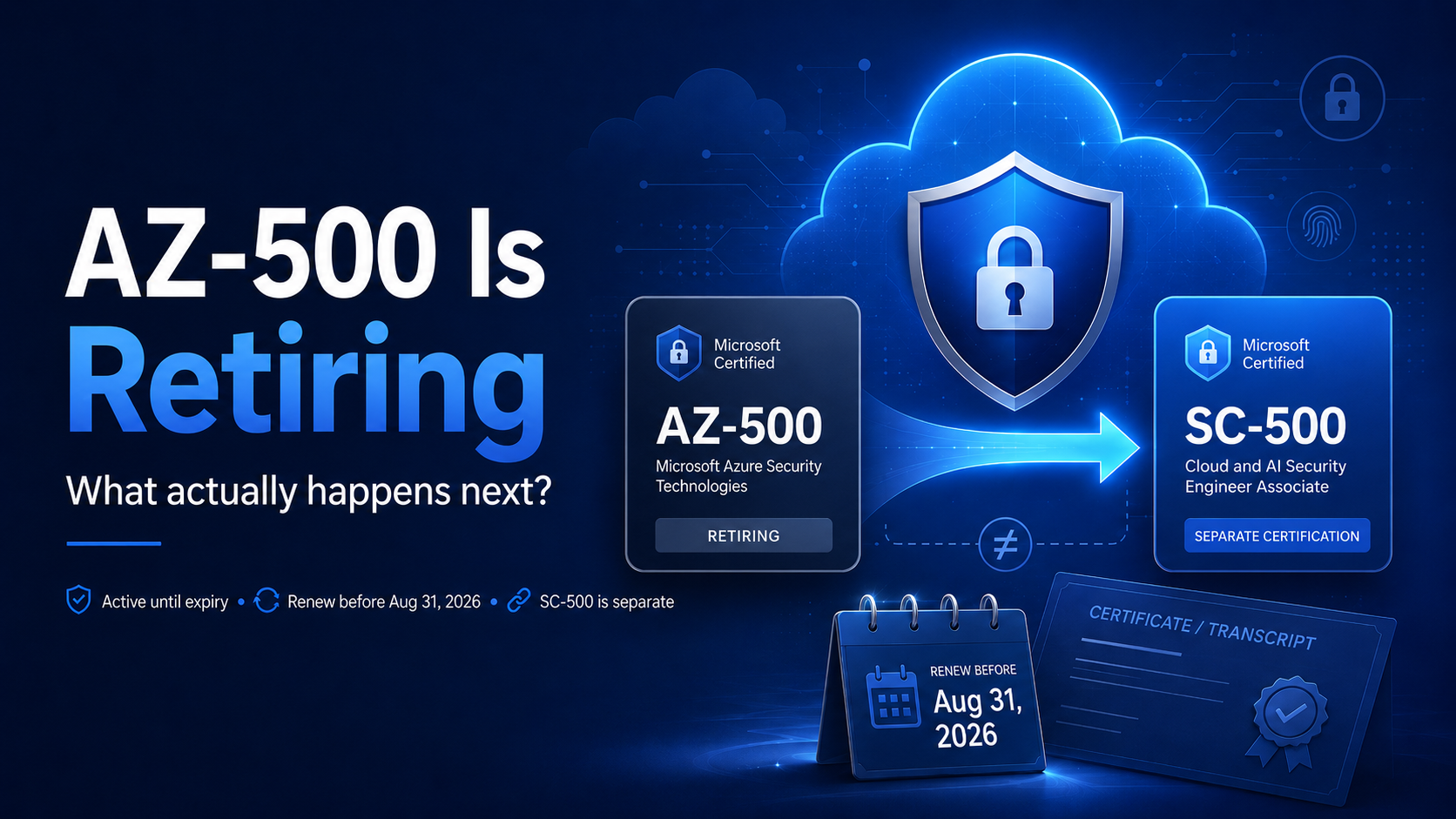
Last checked: August 11, 2026
AZ-500 is retiring. What actually happens next?
Microsoft is retiring Exam AZ-500: Microsoft Azure Security Technologies and the Microsoft Certified: Azure Security Engineer Associate certification on August 31, 2026.[1]
Now the important part: retirement is not the same thing as revocation.
What changes is what you can do going forward.
Your AZ-500 credential can remain valid after the retirement date. What disappears is the ability to earn it again or keep renewing it forever.[2]
That distinction matters.
The three clocks you need to understand
There are three different dates people tend to mix together:
- Exam retirement date — August 31, 2026.
- Certification retirement date — also August 31, 2026.
- Your personal certification expiration date — shown in your Microsoft Learn profile.
The first two are global. The third one is yours.
Microsoft says that after a renewable certification is retired, an already-earned credential remains in the Active Certifications section of your transcript until it reaches its own expiration date. After that, it moves to your historical certifications.[2]
So if your AZ-500 says it expires later than August 31, 2026, the retirement date does not magically shorten the certificate to August 31.
Your credential remains active until the expiration date shown on the credential.
What happens if I can renew AZ-500 right now?
Renew it before retirement if keeping the credential active longer is useful to you.
Microsoft role-based certifications normally open their renewal window six months before expiration. Renewal is free and is done through the online Microsoft Learn renewal assessment.[3]
There is one extra constraint now:
AZ-500 renewal itself retires on August 31, 2026.
Microsoft explicitly says the certification, exam, and renewal assessments retire on that date. Afterward, you will no longer be able to earn or renew AZ-500.[1]
If the Renew button is available in your Learn profile, do not treat August 31 as a theoretical deadline. Do it before then.
When you successfully renew a Microsoft certification, Microsoft extends it one year from the existing expiration date, not one year from the day you clicked Renew.[4]
Example
Suppose your AZ-500 expires on November 15, 2026, and you are eligible to renew before retirement.
You renew on August 20, 2026.
Your certification can then be extended by one year from its current expiration date, so it can remain active well beyond the August 31 retirement date.
But once AZ-500 is retired, there is no second renewal cycle waiting for you next year.
That last renewal is effectively the end of the AZ-500 lifecycle for you.
What if my AZ-500 expires after retirement but I am not eligible to renew yet?
Then there may be nothing to do for AZ-500 itself.
Microsoft only allows renewal during the eligibility window, and a retiring certification can no longer be renewed after its retirement date. Microsoft notes that retirement can affect the renewal window and that the Renew by messaging in Learn takes the retirement date into account.[3]
The practical rule is simple:
Open Microsoft Learn → Profile → Certifications and trust the renewal date shown there.
If AZ-500 gives you a renewal option before August 31, use it if you want the extra validity period.
If it does not, you cannot manufacture a renewal by retaking AZ-500. Microsoft says retaking the certification exam is not an alternative way to renew a certification.[3]
Does my AZ-500 automatically become SC-500?
No.
There is no credential rewrite where:
AZ-500 → SC-500
Your existing Azure Security Engineer Associate credential remains its own credential until it expires.
Microsoft’s new forward path is:
Microsoft Certified: Cloud and AI Security Engineer Associate
Exam: SC-500 — Implementing End-to-End Security Controls for Cloud and AI Workloads
Microsoft’s transition guidance tells learners who are not already close to taking AZ-500 to prepare for and take SC-500 instead.[5]
There is currently no automatic upgrade credit, conversion, or bridge exam that turns an AZ-500 holder into an SC-500 holder.
If you want the new credential on your profile, you need to earn SC-500 separately.
Is SC-500 just AZ-500 with a new number?
No — and this is the interesting part.
AZ-500 was primarily about securing Azure infrastructure: identity, networking, compute, storage, databases, Defender for Cloud, and Sentinel.
SC-500 keeps a large part of that foundation, but the security boundary is wider.
Microsoft describes the new role as protecting systems and data across Azure, hybrid, and AI-enabled environments. It explicitly adds responsibility for securing the platforms, identities, data, infrastructure, and agents used by AI workloads.[6]
The SC-500 blueprint is currently organized around four domains:[7]
- Manage identity, access, and governance — 20–25%
- Secure storage, databases, and networking — 25–30%
- Secure compute — 20–25%
- Manage and monitor security posture — 20–25%
And inside those domains Microsoft now includes topics such as:
- Microsoft Entra ID, PIM, Conditional Access, managed identities, and Key Vault.
- Azure Policy, Defender for Cloud, regulatory compliance, RBAC, and infrastructure as code.
- Azure networking, Private Link, Firewall, storage, and database security.
- AKS, containers, App Service, Functions, APIs, and hybrid/multicloud server security.
- AI workload security, including Microsoft Foundry controls, AI Gateway, Defender for AI, Entra Agent ID, Copilot-related risk, and agent security.
- Microsoft Sentinel and Microsoft Security Copilot.
So the mental model is:
AZ-500 asks: can you secure Azure?
SC-500 asks: can you secure the modern cloud estate — including AI workloads — end to end?
That is why I would not think of SC-500 as a simple rename. It is an expansion of the security engineer role.
What should an existing AZ-500 holder do?
| Situation | Recommended move |
|---|---|
| Your AZ-500 is active and Renew is available | Renew before August 31, 2026 if the additional active period is valuable to you. |
| Your AZ-500 is active but Renew is not available | Keep using the credential until its displayed expiration date. Start preparing for SC-500. |
| Your AZ-500 expires before August 31, 2026 | Renew before your personal expiration date. Your own expiry is the earlier deadline. |
| You want the current Microsoft cloud-security credential | Plan to earn SC-500 separately. AZ-500 does not automatically convert. |
| You are studying AZ-500 but have not booked/taken it | Unless you specifically need AZ-500 before retirement and are ready now, move your study plan to SC-500. |
My recommendation
If you already hold AZ-500, do two separate things:
- Preserve the old signal if it is cheap to preserve. If Microsoft Learn gives you the AZ-500 renewal assessment, take it before retirement. It is free, and passing it can extend the credential from its current expiry date.[4]
- Build the next signal instead of clinging to the old one. Start mapping your AZ-500 knowledge to SC-500, especially the areas that are genuinely new: AI workload security, Security Copilot, agent identity/security, broader application-platform security, and modern Defender controls.[7]
Do not think of this as Microsoft deleting the work you already did.
Think of it as a protocol migration.
Your old certificate proves what you knew and when you proved it. It remains on your transcript. The new certification is Microsoft saying, the security engineer boundary has moved; here is the new contract.
FAQ
Will AZ-500 disappear from my Microsoft transcript on August 31, 2026?
No. An earned certification remains on your transcript. For a renewable role-based certification such as AZ-500, it remains active until its own expiration date, then moves to the historical section.[2]
Can I renew AZ-500 after August 31, 2026?
No. Microsoft says the certification and its renewal assessments retire on August 31, 2026.[1]
Can I renew by simply retaking AZ-500?
No. Microsoft says the renewal assessment is the renewal mechanism; retaking the certification exam is not an alternative renewal path.[3]
Will Microsoft upgrade my AZ-500 to SC-500 automatically?
No automatic conversion has been announced. SC-500 is a separate certification with its own exam and expanded objectives.[6]
Is SC-500 available now?
Yes. As of this article’s August 11, 2026 check, Microsoft Learn lists Microsoft Certified: Cloud and AI Security Engineer Associate and provides the option to schedule Exam SC-500.[6]
If I already know AZ-500, am I starting from zero for SC-500?
Knowledge-wise, absolutely not. There is substantial overlap in identity, network, compute, storage, Defender for Cloud, governance, and monitoring. Credential-wise, however, SC-500 is earned separately. Your best strategy is to reuse your AZ-500 foundation and focus study time on the expanded SC-500 objectives.[7]