The Windows XP FCKGW Key: An Engineering Breakdown
Why the famous Windows XP FCKGW key worked only with matching Volume Licensing media—and what its leak teaches us about bypass paths, static secrets, and revocation.
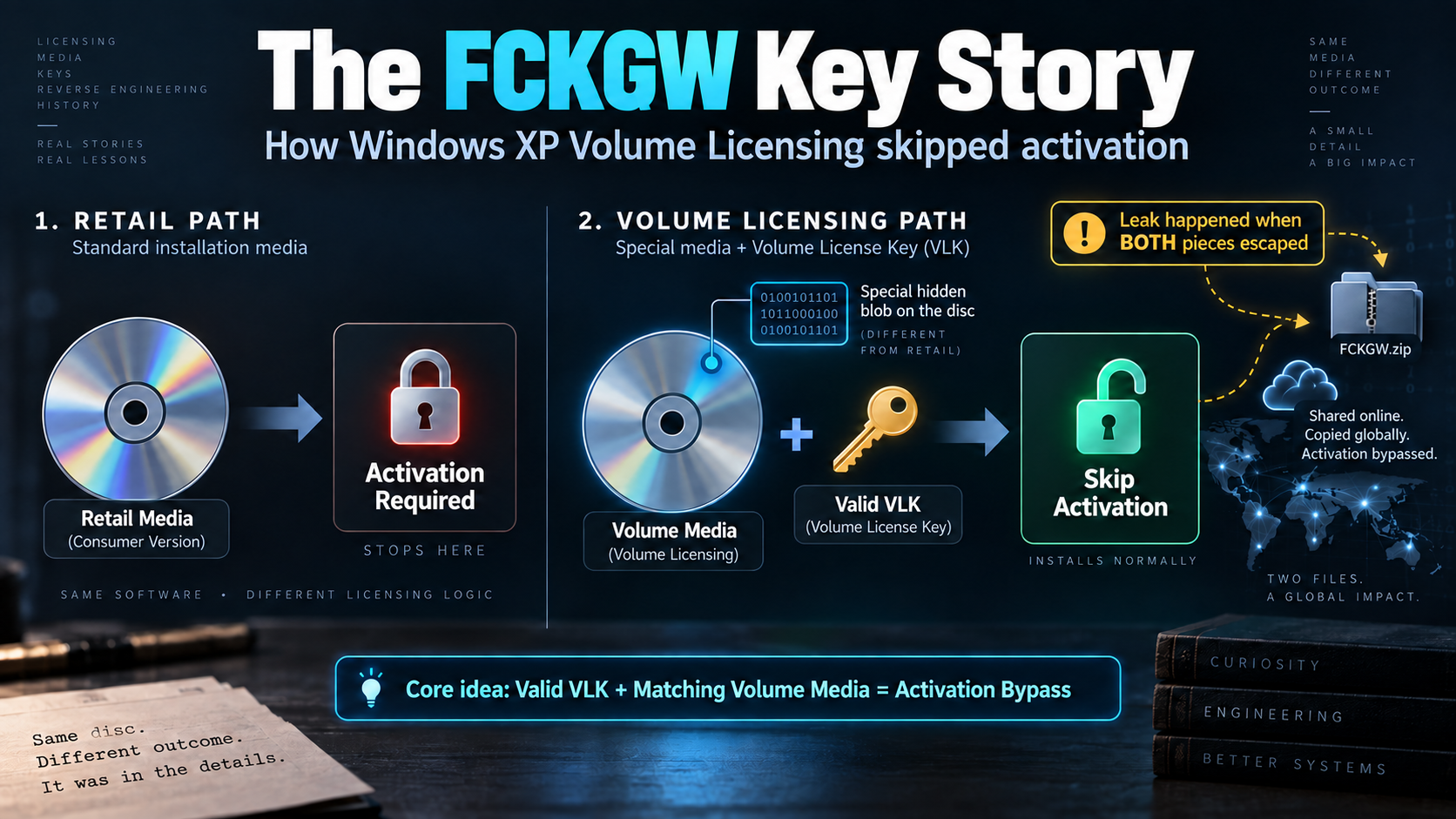
There is a famous Windows XP product key:
FCKGW-RHQQ2-YXRKT-8TG6W-2B7Q8
If you used computers in the early 2000s, you probably saw it written on CDs, posted on forums, or baked directly into pirated Windows XP images.
But the interesting part is not the key itself. The interesting part is the architecture behind it.
Because this story is really about one thing:
What happens when you design a secure system with a trusted bypass path, and that bypass escapes into the public?
Let’s break it down.
How Windows XP Activation Normally Worked
When Microsoft introduced Windows XP, it also introduced Windows Product Activation. The goal was simple: prevent one retail copy of Windows from being installed on unlimited machines.
A normal installation roughly looked like this:
1
2
3
4
5
6
7
8
9
10
11
12
13
Install Windows
      |
      v
Enter and validate the product key
      |
      v
Generate a hardware identity
      |
      v
Activate with Microsoft
      |
      v
Activation approved
The important part is the hardware identity. Windows collected information about the machine and created a fingerprint. Your license was no longer just:
1
Product Key
It was closer to:
1
Product Key + Machine
That is a much stronger licensing model. You cannot simply take the same retail key and install it everywhere without eventually triggering activation problems.
But then Microsoft had another problem.
Enterprise Customers Break the Model
Imagine you are a company with 10 PCs. Activation is annoying, but manageable.
Now imagine 100,000 PCs. Some may not have Internet access. Some may exist in secure environments. Others may be installed automatically through deployment systems.
Microsoft could not realistically tell a giant enterprise:
Please activate these 100,000 computers one by one.
So Microsoft created another path: Volume Licensing.
Windows XP effectively had two distribution channels:
1
2
3
Retail Media + Retail Key
             =
     Activation Required
1
2
3
Volume Media + Volume License Key
             =
      Activation Skipped
This is a very important design decision. Microsoft did not simply create a magic key that worked everywhere. The key was supposed to work only with special installation media.
Think of it as two conditions:
1
2
3
4
5
6
IF
    key == valid_volume_key
AND
    media == volume_media
THEN
    skip_activation
That second condition mattered. A leaked volume key alone should not have been enough.
How Did Windows Know It Was Volume Media?
Windows Setup needed a way to distinguish a retail CD from corporate Volume Licensing media.
According to former Microsoft engineer Dave Plummer’s account, the installation media contained a special binary blob. Its contents were not important; its presence acted as a recognizable property of the media.
And now we arrive at one of the funniest details in Windows history: the source material for that blob was Microsoft Bob—the famously unsuccessful Microsoft graphical interface from the 1990s.
The data was processed, compressed, and encrypted multiple times before being placed on the installation media. Conceptually:
1
2
3
4
5
6
7
8
9
10
Microsoft Bob data
       |
       v
Compression and encryption
       |
       v
~10 MB binary blob
       |
       v
Windows XP installation media
The actual content did not matter. Its presence did. Windows could verify something derived from this data and identify the expected media channel.
The Microsoft Bob detail comes from Plummer’s later account of the implementation, not from a public Windows XP protocol specification.
This is effectively a media-bound licensing signal.
Why FCKGW Did Not Work on Every Windows XP CD
This is the part many people misunderstood. The famous FCKGW key was not simply a universal Windows XP key.
If you tried:
1
2
3
Retail Windows XP CD
+
FCKGW key
it should fail, because the retail disc did not match the key’s licensing channel.
You needed:
1
2
3
Volume Windows XP ISO
+
Valid Volume License Key
When both conditions were satisfied, Windows followed the enterprise path. On that path, hardware activation was skipped.
That is why the leak became so powerful. The attackers did not just get the password. They got the entire trusted environment.
A Two-Artifact Trust Model
You can almost think about Microsoft’s design as requiring two things:
- A valid Volume License Key.
- Authentic Volume Licensing media.
Together:
1
VLK + Volume Media = Offline enterprise installation
From Microsoft’s perspective, this made sense. Volume keys were controlled. Volume media was controlled. Only trusted enterprise partners and large customers should have had access.
But there is a fundamental security principle here:
If possession of two secret artifacts grants unlimited trust, leaking both artifacts destroys the trust model.
And that is exactly what happened.
The Trust Boundary Expanded
Windows XP reached Release to Manufacturing on August 24, 2001. Retail launch was planned for October 25.
Between those dates Microsoft needed to give the final product to OEMs, hardware vendors, manufacturing partners, and enterprise partners. Dell, HP, and others could not receive Windows XP on October 25 and magically have millions of computers ready that same morning.
So Microsoft’s trust boundary expanded:
1
2
3
4
5
6
Microsoft
   |
   +-- OEMs
   +-- Hardware partners
   +-- Enterprise licensing partners
   +-- Manufacturing systems
Every additional organization became another potential leak point.
Several weeks before launch, the warez group commonly known as Devil’s Own distributed something extremely valuable: not a beta, not a hacked build, but a final Windows XP Professional Corporate image.
And with it came the FCKGW key.
Notice what leaked:
1
Key + Correct Volume Media
The complete trust package had escaped.
The Security System Was Not Necessarily Broken
This is an important engineering distinction.
Hackers did not need to break the cryptography, reverse Microsoft’s product-key mathematics, defeat hardware fingerprinting, or bypass Windows Product Activation.
The system itself said:
1
2
3
4
5
Valid Volume Key?   YES
Valid Volume Media? YES
Enterprise customer? Assume yes

Skip activation.
The software behaved as designed. The assumptions behind the design were no longer true.
1
2
3
4
5
Possession of Volume Media
+
Possession of VLK
=
Trusted enterprise
After the leak, anyone on the Internet could possess both. The identity assumption collapsed.
If you want another example of identity being inferred from machine data, see LinkedIn’s browser fingerprinting architecture. Different system, same lesson: a signal is useful only while its assumptions hold.
The Bypass-Path Problem
A lot of security incidents are not cryptographic failures. They are trust failures.
You can have AES, RSA, hashes, digital signatures, hardware fingerprints, and activation servers—and still lose. Somewhere in the architecture there may be:
1
2
if trusted_customer:
    bypass_security()
The question becomes: How do you prove trusted_customer?
Windows XP Volume Licensing effectively answered:
1
2
3
Does this machine have the expected media?
AND
Does it have a valid Volume License Key?
That works only while those artifacts remain controlled.
The entire point of Volume Licensing was to avoid the normal activation path. Once an attacker entered the volume path, the strongest part of the retail protection mechanism never executed.
sequenceDiagram
    autonumber
    participant Setup as Windows Setup
    participant Media as Installation Media
    participant Key as Product Key Logic
    participant WPA as Activation Service

    Setup->>Media: Identify licensing channel
    Media-->>Setup: Retail or Volume
    Setup->>Key: Validate key for that channel
    alt Retail path
        Key-->>Setup: Valid retail key
        Setup->>WPA: Send key + hardware identity
        WPA-->>Setup: Activation decision
    else Volume path
        Key-->>Setup: Valid VLK
        Setup->>Setup: Trust matching volume artifacts
        Note over Setup: Skip normal activation
    end
You can spend enormous effort securing the main authentication path while creating an administrative path that completely bypasses it.
Modern examples include emergency admin accounts, recovery tokens, API master keys, service credentials, debug modes, factory provisioning keys, and internal certificates.
Every bypass becomes part of your security architecture. The same principle appears in infrastructure isolation: the primary boundary is only as strong as the privileged escape paths around it. I explored that idea in The Architecture of Isolation.
Why FCKGW Became Legendary
The key spread quickly. Pirated XP CDs appeared with it preconfigured in the installer—or literally written on the disc.
From the user’s perspective, the experience was incredible:
1
2
3
4
Install Windows XP
Enter the key
No activation
Windows boots normally
Pirated Windows looked almost exactly like licensed corporate Windows because the operating system believed it was running under the legitimate corporate licensing mechanism.
Microsoft could not simply remove Volume Licensing. Huge companies legitimately depended on it. Imagine deploying an XP service pack and suddenly telling a Fortune 500 company:
By the way, activate your 200,000 machines individually.
Not happening.
So Microsoft attacked the leaked credentials instead. Windows XP Service Pack 1 began rejecting known leaked product keys and associated Product IDs. The architecture evolved from:
1
Do you possess a valid key?
toward:
1
Is this license actually authorized?
That difference is huge.
Authentication, Authorization, and Revocation
The old model relied heavily on authentication by possession:
1
2
3
You possess Volume media + Volume key
therefore
you are authorized.
But possession is not identity.
Modern licensing systems increasingly check a server-side entitlement:
1
2
3
4
5
6
7
License ID
    |
    v
Server verifies organization, device, and policy
    |
    v
Authorization decision
That gives the vendor something incredibly valuable: revocation.
Suppose your licensing model is entirely offline. You issue a master key, and your software verifies it locally. If that key leaks, potentially nothing can stop it because every existing copy already knows how to validate it.
But if authorization depends on a server, a leaked credential can be disabled centrally. That is why modern systems often trade some offline convenience for control.
This does not make the online design free. Now availability depends on a network path, DNS, TLS, and the authorization service itself. If you want to unpack that transport layer, start with What Is TLS/SSL?.
The Real Engineering Trade-Off
Microsoft’s engineers were not making an irrational decision. They were solving a real operational problem:
1
2
3
4
5
6
7
8
Enterprise requirement:
- 100,000 machines
- Offline networks
- Automated deployment
- No activation friction

Security requirement:
- Prevent ordinary users from bypassing activation
Those requirements conflict.
Microsoft chose:
1
Volume Media + Volume Key = Offline trust
For legitimate customers, this was extremely convenient. But convenience came from moving the trust decision from Microsoft’s servers into static artifacts.
Static secrets are dangerous because they can be copied. And digital copying has essentially zero marginal cost:
1
1 copy -> 10 copies -> 1,000 copies -> 1,000,000 copies
Nothing is free in software engineering. Microsoft traded revocability and centralized control for offline deployment, low operational friction, and massive enterprise scale.
The Engineering Lesson Behind FCKGW
The legendary FCKGW key was not powerful because somebody discovered a magical Windows XP master password. It became powerful because it was attached to an official Microsoft trust path.
The system effectively said:
1
2
3
I trust this key.
I trust this media.
Therefore I trust this installation.
For legitimate enterprise customers, that assumption was reasonable. Then the Internet obtained both pieces, and the system confidently authenticated the wrong people.
That is why this story is much more interesting than “someone leaked a Windows key.”
It is a story about systems security. A trusted offline capability was represented by copyable artifacts. Those artifacts escaped. Once they did, no cryptographic sophistication inside the normal activation workflow mattered, because the normal workflow never ran.
The weakest part of a security system is often not the lock.
It is the legitimate door designed to avoid using the lock.
How many legitimate bypass paths exist in your architecture—and what happens when one escapes?