HTTP/2 over TCP vs HTTP/3 over QUIC
Greeting Users and programs today are diving deep into the plumbing of the internet. We are going to strip away the abstractions and look at the bare metal difference between HTTP/2 over TCP/TLS and HTTP/3 over QUIC.
If you are building high-performance backends, designing APIs, or tuning reverse proxies like NGINX or Envoy, understanding this shift isn’t optional. It completely alters how your servers process bytes coming off the wire.
First, Compare the Right Layers
HTTP/2 and HTTP/3 are application-layer protocols. QUIC is a transport that can carry HTTP/3, SMB, MASQUE, and other protocols. This article therefore compares HTTP/2 over TCP/TLS with HTTP/3 over QUIC; discussions of requests, headers, and HTTP streams belong to HTTP, while QUIC provides the transport streams underneath.
The Core Problem: Why Did We Move Past HTTP/1.x?
To understand HTTP/2 and HTTP/3 over QUIC, we have to look at what they were trying to fix. In the ancient days of HTTP/1.1, if you wanted to fetch 100 images, the browser had to open up to 6 parallel TCP connections, or queue the requests sequentially. This caused massive application-level Head-of-Line (HoL) blocking.
HTTP/2 arrived and solved this beautifully at the application layer. It introduced multiplexing over a single TCP connection. It chopped up HTTP requests and responses into tiny binary frames, interleaved them, and sent them down one pipe.
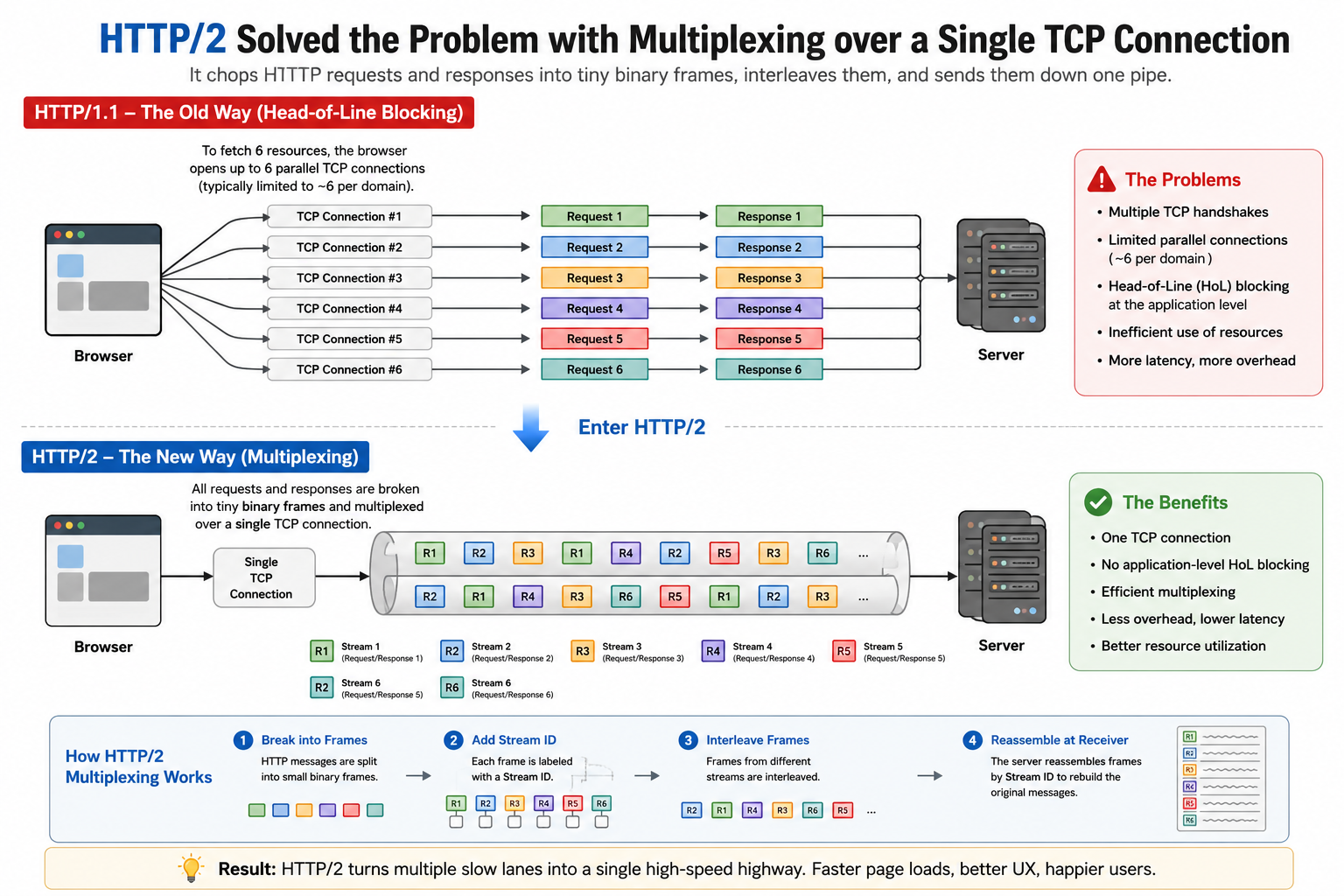
But HTTP/2 introduced a dark architectural trade-off that networking engineers quickly bumped into. Let’s look at the stack shift first.
Visualizing the Stack Shift
Here is how the architecture fundamentally changes when you transition from HTTP/2 over TCP/TLS to HTTP/3 over QUIC:
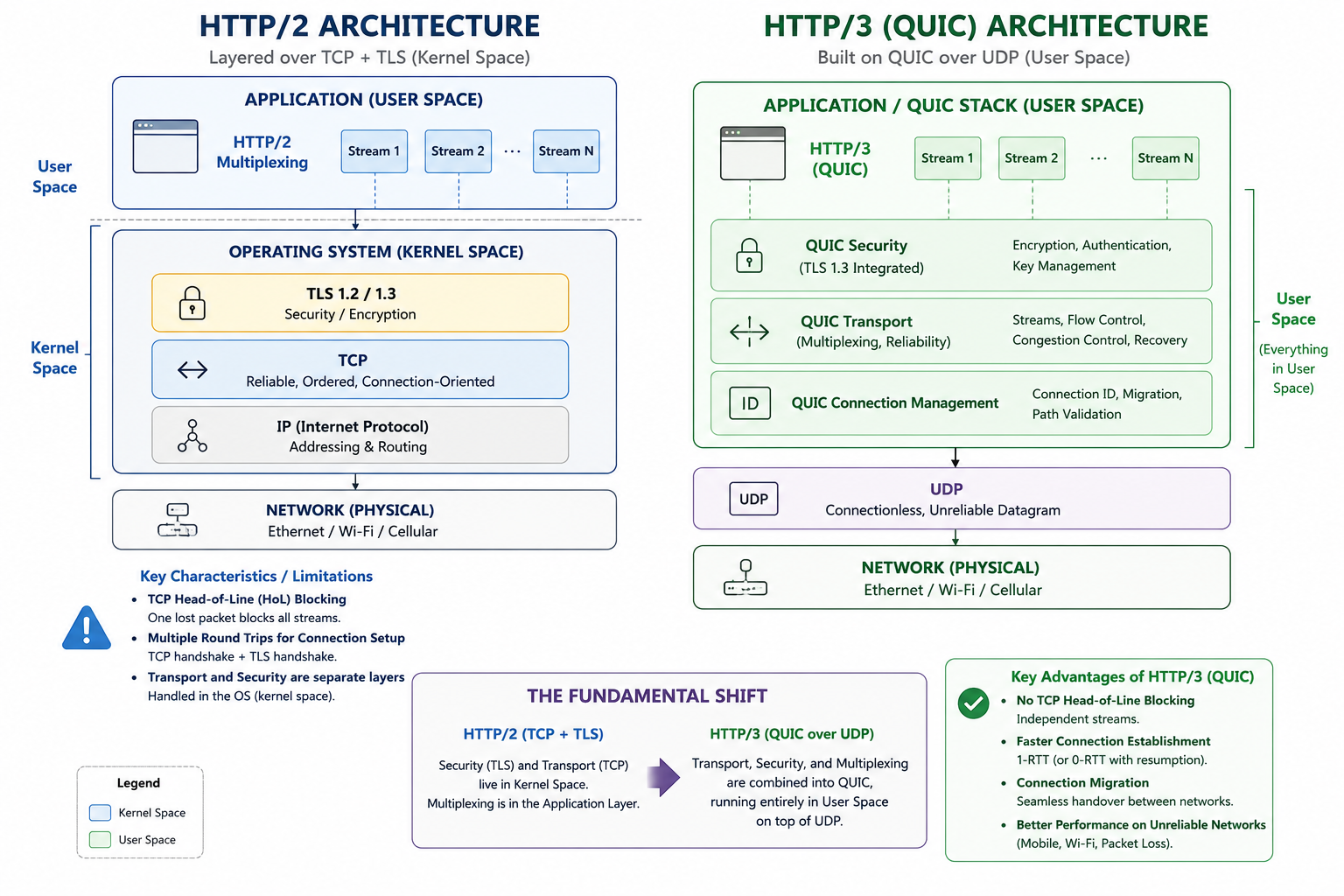
Notice where the boundaries lie. In HTTP/2, security (TLS) and transport (TCP) are distinct silos living inside the operating system’s kernel space, while multiplexing is handled up top by the application layer. HTTP/3 maps its HTTP streams onto QUIC transport streams. QUIC combines transport, TLS integration, and stream multiplexing in user space on top of UDP.
The Technical Deep Dive: 4 Architectural Battles
1. The Head-of-Line Blocking Showdown: HTTP/2 vs HTTP/3
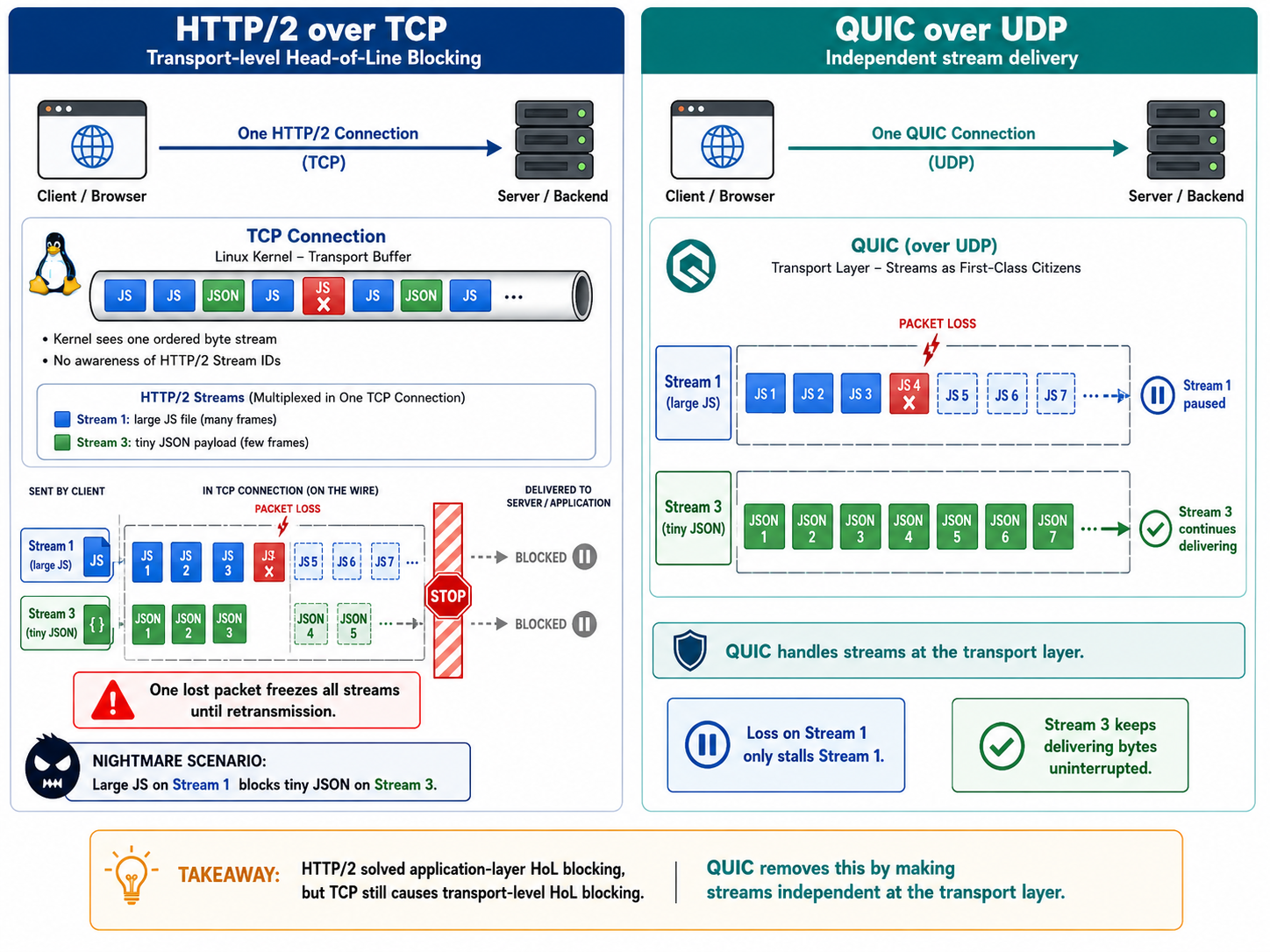
While HTTP/2 solved application-level HoL blocking, it introduced Transport-level Head-of-Line blocking.
Because HTTP/2 relies on a single TCP connection, the Linux kernel views the entire stream of data as one continuous, sequential buffer. The kernel doesn’t know what an HTTP/2 “Stream ID” is.
- The HTTP/2 Nightmare: Imagine you are downloading a large JS file on Stream 1 and a tiny JSON payload on Stream 3. If the IP packet containing a chunk of the JS file gets dropped in transit, TCP halts everything. It refuses to deliver the JSON bytes to the application until the dropped JS packet is retransmitted and acknowledged. One bad packet freezes all streams.
- The HTTP/3 over QUIC advantage: QUIC replaces TCP with a transport built on UDP where streams are first-class citizens. If a packet containing data for HTTP/3 Stream 1 is lost, QUIC holds up Stream 1 while Stream 3 can continue delivering bytes to the HTTP/3 layer.
2. Handshake Latency: Round Trips Count
Time to First Byte (TTFB) is heavily dictated by connection setup overhead. When a client connects to your backend using HTTP/2 over TCP/TLS, it has to perform a multi-step dance:
1
2
3
4
5
6
7
HTTP/2 Connection Setup (TCP + TLS 1.3):
Client                   Server
  | --- TCP SYN --------> |
  | <-- TCP SYN-ACK ----- |  [1 RTT - TCP Done]
  | --- TLS ClientHello -> |
  | <-- TLS ServerHello -- |  [2 RTT - TLS Done]
  | === HTTP/2 Stream === |  Ready for Data
That is at least 2 Round Trip Times (RTT) before a single byte of HTTP data is processed. If you are using TLS 1.2, it is 3 RTTs.
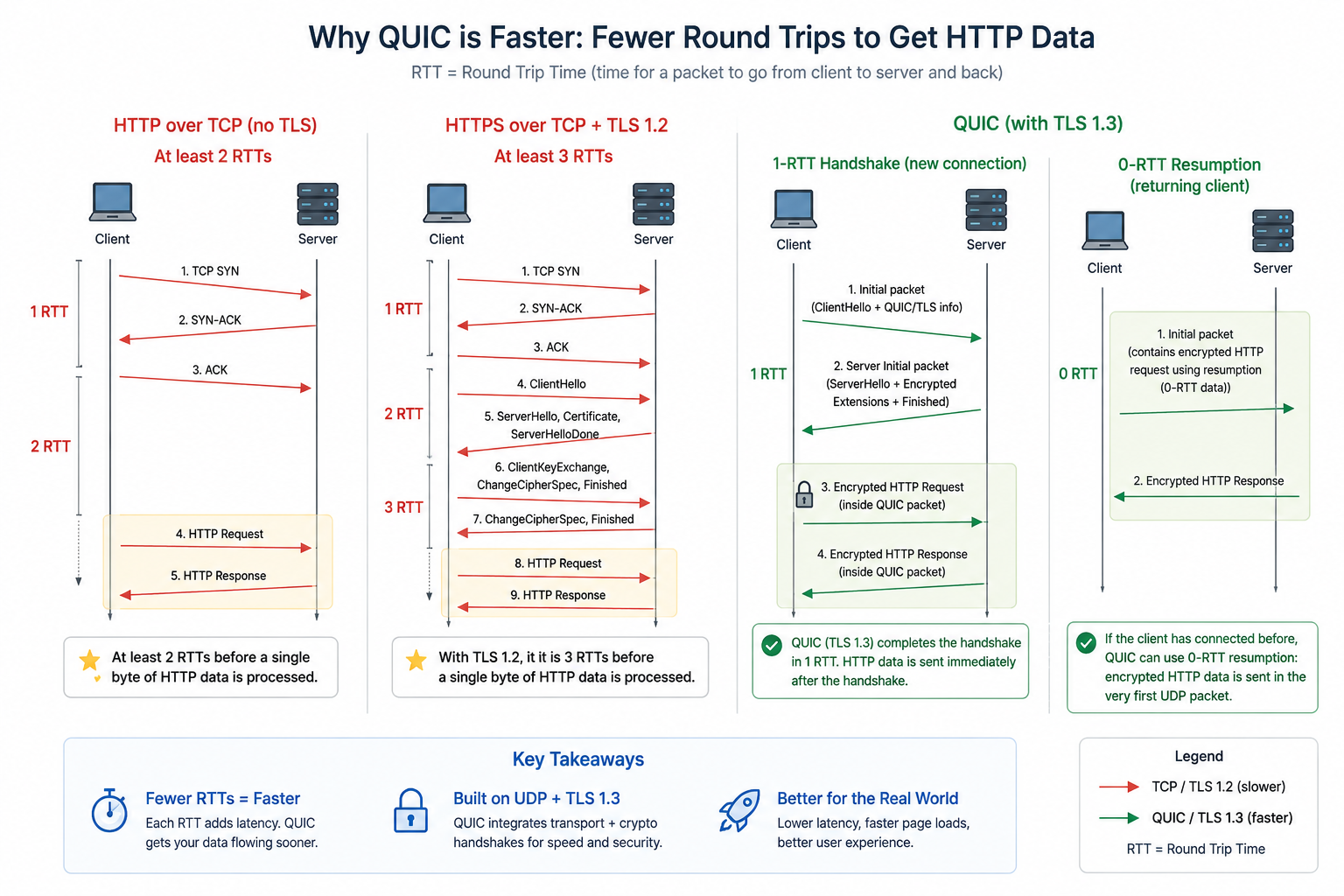
HTTP/3 over QUIC tightly integrates the transport handshake with TLS 1.3. It achieves a 1-RTT handshake out of the box. If the client has connected to your backend before, it can use 0-RTT resumption to send encrypted HTTP data in the first UDP packet.
0-RTT safety: Encryption does not provide replay protection for early data. Enable 0-RTT only for replay-safe, idempotent requests; a server can reject early data and the client may need to resend after the handshake. For any operation where replay matters, add application-level replay defenses.
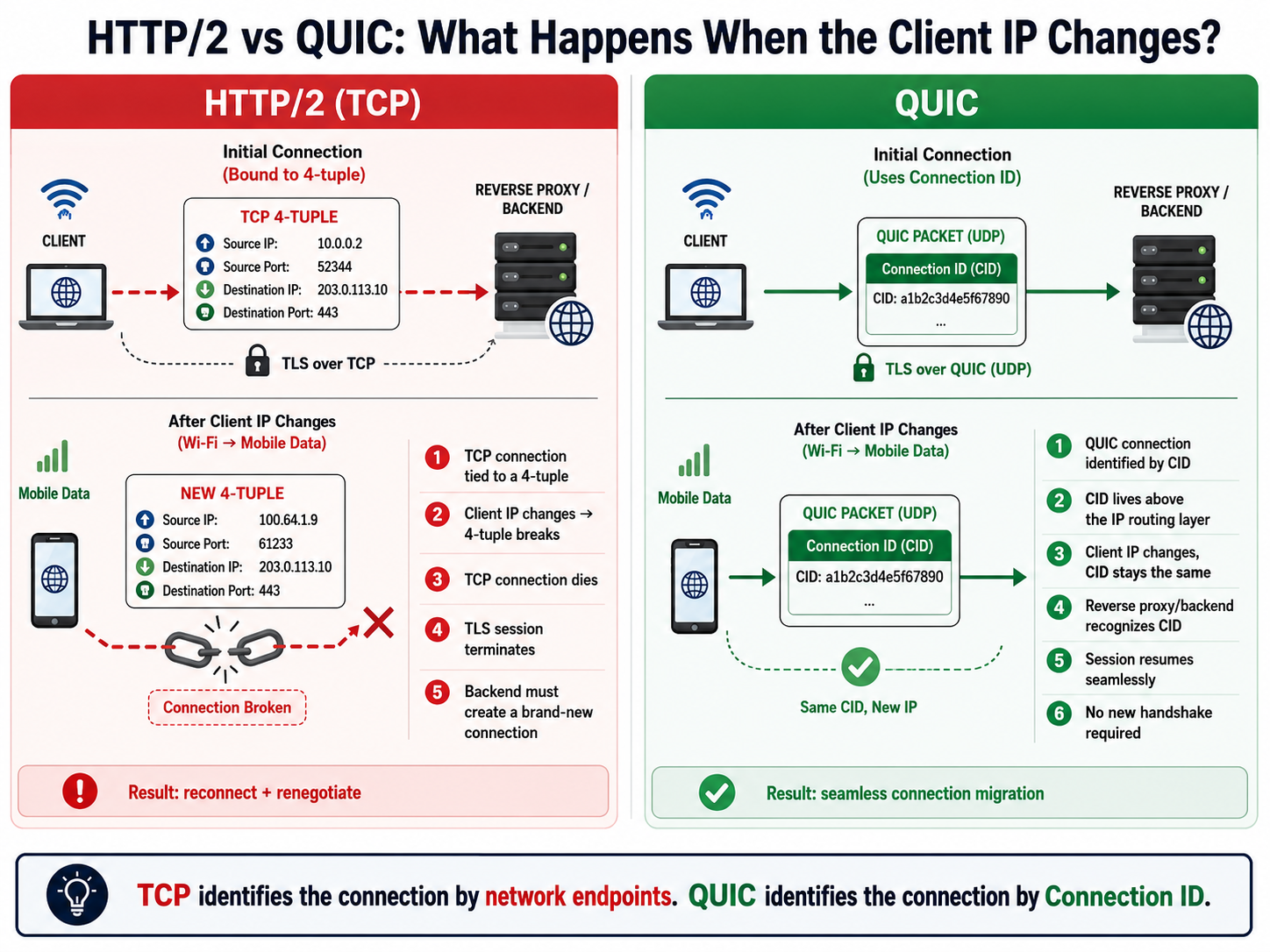
3. Connection Migration (The Mobile World)
We live in a world where clients constantly switch networks—like walking out of your house and dropping Wi-Fi to hop onto a cellular 5G network.
- In HTTP/2 over TCP: A TCP connection is strictly tied to a 4-tuple:
Source IP,Source Port,Destination IP, andDestination Port. The moment the client’s IP changes, the 4-tuple breaks. The TCP connection dies, the TLS session terminates, and your backend server has to tear down the socket and re-negotiate a brand new connection. - In HTTP/3 over QUIC: Connection IDs let the connection survive a 4-tuple change, but migration is not simply reusing one CID. The endpoint normally selects an unused peer-issued CID when available, authenticates the protected packet, and validates the new path with
PATH_CHALLENGEandPATH_RESPONSE; anti-amplification limits apply until that path is validated. The HTTP/3 session can then continue without a new TLS handshake.
4. Kernel Space vs. User Space Performance
This is where backend engineers need to pay strict attention to resource utilization.
TCP is deeply optimized and baked into the operating system kernel. Over decades, hardware manufacturers created TCP Offload Engines (TOE) on Network Interface Cards (NICs), allowing the hardware itself to handle checksums and packet segmentation.
QUIC runs in User Space. Because UDP implementation in many legacy OS kernels was built for fast, low-volume payloads (like DNS), pushing massive streams of enterprise data through UDP forces the CPU to perform millions of context switches via recvmsg and sendmsg system calls.
Backend Warning: Upgrading your reverse proxy to QUIC/HTTP3 can cause a significant spike in CPU utilization (often 2x to 3x compared to HTTP/2 over TCP for the same throughput) until you optimize your kernel’s UDP buffers and implement technologies like GSO (Generic Segmentation Offload).
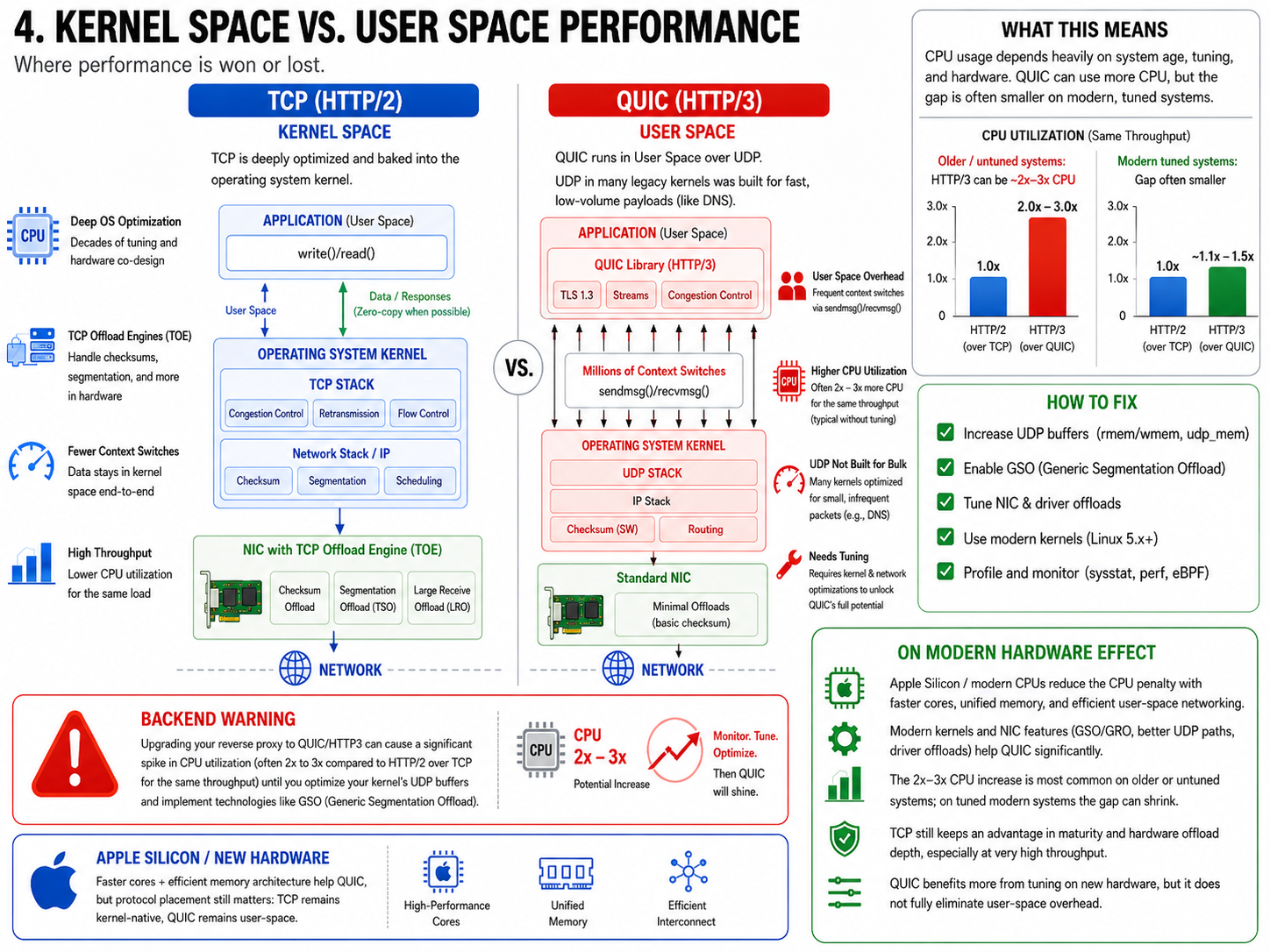
Modern hardware and kernels substantially reduce QUIC’s CPU disadvantage, but they do not eliminate it completely.
What newer systems provide
Modern NICs and operating systems support UDP-oriented acceleration:
- UDP Segmentation Offload (USO / UDP GSO): The QUIC implementation submits a large buffer containing multiple packets through one syscall; the kernel or NIC splits it into MTU-sized UDP datagrams. This reduces syscall, descriptor, and per-packet processing overhead. Linux explicitly supports UDP segmentation offload, while Windows has supported hardware USO since Windows 10 version 2004. (Kernel Documentation)
- UDP GRO/URO: Multiple received UDP datagrams can be coalesced before being passed upward, reducing interrupts and per-packet processing. Windows 11 24H2 introduced hardware UDP Receive Segment Coalescing, and Linux supports the corresponding GRO mechanisms. (Microsoft Learn)
- Multi-queue NICs and RSS: Traffic can be distributed across CPU cores. Newer QUIC-specific proposals use the QUIC Connection ID rather than only the traditional five-tuple, preserving correct steering when a client changes its IP address or port. (GitHub)
- Hardware cryptography: AES-NI, VAES, ARM crypto extensions and similar instructions accelerate QUIC’s AEAD encryption. However, QUIC still performs encryption and header protection on individual packets, while TCP with TLS often processes larger TLS records. (arXiv)
- Emerging QUIC NIC offloads: QUIC encryption offload, CID-aware RSS, UDP receive coalescing and packet-transmission scheduling are being designed for modern NICs and SmartNICs, although they are not yet universally available on ordinary servers. (GitHub)
What remains expensive
Even with modern hardware, most NICs still do not implement QUIC’s complete reliability, ACK generation, loss recovery, congestion control and stream management. Those remain in the user-space QUIC library.
Also, sendmsg() and recvmsg() do not necessarily cause full process context switches every time. A more accurate description is that they cause system calls and user/kernel crossings, plus memory, socket and per-packet processing. GSO, GRO, sendmmsg, recvmmsg and similar batching techniques reduce the number of these operations. The quic-go documentation, for example, describes GSO specifically as a way to amortize sendmsg overhead across multiple QUIC packets.
Does QUIC still consume 2–3× the CPU?
That should not be presented as a universal number.
On a modern CPU, current Linux kernel and compatible NIC—with UDP GSO/GRO, large buffers, multiple receive queues and optimized QUIC software—the gap can be much smaller. But at very high throughput, especially on 10/25/100 GbE links, QUIC may still become CPU-bound sooner than TCP because TCP benefits from decades of mature TSO, GRO, kernel processing and TLS offload. Research measurements show enormous variation between QUIC implementations, from hundreds of Mbit/s to several Gbit/s, rather than one consistent CPU multiplier. (arXiv)
A more accurate warning for your article would be:
Backend Warning: QUIC can consume more CPU than HTTP/2 over TCP, particularly at high throughput or when UDP batching and receive offloads are unavailable. Modern kernels and NICs narrow this gap through UDP GSO/USO, GRO/URO, RSS and hardware cryptography, but QUIC’s encrypted packet processing, acknowledgements, congestion control and stream management still largely execute in user space. Benchmark your specific QUIC stack, kernel and NIC instead of assuming a fixed 2×–3× penalty.
One other correction: full TCP Offload Engines are less universal than the original text implies. Modern deployments more commonly rely on partial/stateless features such as checksum offload, TSO, GRO, RSS and TLS offload rather than transferring the entire TCP state machine to the NIC.
Architectural Comparison Matrix
| Architectural Feature | HTTP/2 over TCP/TLS | HTTP/3 over QUIC |
|---|---|---|
| Transport Protocol | TCP (connection-oriented, kernel space) | QUIC over UDP (transport engine in user space) |
| Multiplexing Layer | Application layer (HTTP/2 frames) | HTTP/3 maps onto native QUIC transport streams |
| Head-of-Line Blocking | Exposed to TCP transport-level blocking | Avoids cross-stream transport-level blocking |
| Handshake Overhead | 2 to 3 RTTs | 1 RTT (or 0 RTT on reconnection) |
| Connection Stability | Breaks on IP/Port change (4-tuple constraint) | Supports CID-based migration with path validation |
| CPU Overhead at Server | Low (Optimized by kernel & NIC hardware) | High (Context switching, requires UDP tuning) |
Where QUIC has a clear real-world advantage
Very few applications require QUIC to function. Most production systems retain HTTP/2 as a fallback because some firewalls and enterprise networks block UDP/443.However, in several markets, QUIC has become effectively must-have for competitive performance or architecture.
1. YouTube and large-scale video streaming
YouTube is probably the best-known and strongest QUIC success story.
Google reported that moving from HTTP over TLS 1.3/TCP to IETF QUIC produced:
- More than 9% lower video rebuffer time
- More than 7% higher throughput on mobile
- More than 3% higher throughput on desktop
- More than 2% lower Google Search latency
Chrome enabled HTTP/3 by default, and Google uses its production QUIC stack across Chrome, Google servers and services such as YouTube. (blog.google)
QUIC is especially valuable for video because a viewer may experience:
- Packet loss on cellular networks
- Rapid bandwidth fluctuations
- Wi-Fi-to-5G transitions
- Long-lived connections
- Concurrent video, subtitles, ads, analytics and API traffic
With HTTP/2 over TCP, a lost TCP packet can temporarily block all HTTP streams on that connection. With HTTP/3 over QUIC, loss affecting one stream does not necessarily stop unrelated streams.
Verdict: For global mobile video platforms, HTTP/3 is close to a must-have.
2. Facebook and Instagram mobile applications
Meta deployed its own QUIC implementation, mvfst, across Facebook and Instagram, including the iOS and Android Instagram applications and their web properties.
Meta’s motivation was not merely faster page loading. It wanted a transport it could modify and deploy independently of operating-system TCP stacks, particularly for:
- Mobile connections
- Lossy last-mile networks
- Connection migration
- Congestion-control experimentation
- Large numbers of parallel API and media streams
Meta described its deployment as bringing QUIC to billions of users and planned for QUIC to represent the majority—and eventually potentially all—of Facebook’s internet traffic. (Engineering at Meta)
A typical Instagram session simultaneously loads:
1
2
3
4
5
6
7
8
Feed metadata
Images
Video segments
Comments
Messages
Notifications
Ads
Analytics events
Independent QUIC streams used by HTTP/3 prevent one delayed resource from unnecessarily blocking all the others.
Verdict: For mobile-first social networks with media-heavy feeds, QUIC offers a very clear advantage.
3. Microsoft SMB over QUIC
This is one of the clearest examples where QUIC enables an entirely different product architecture, rather than merely improving performance.
Microsoft’s SMB over QUIC allows Windows users to access enterprise file shares remotely using:
1
2
3
4
5
SMB
  ↓
QUIC + TLS 1.3
  ↓
UDP port 443
SMB over QUIC carries modern SMB semantics over an authenticated, encrypted transport while avoiding public TCP/445 exposure. It does not replace SMB authorization or remove the server attack surface.
Microsoft describes it as an “SMB VPN” for remote workers, mobile users and high-security organizations. It is available with Windows 11 clients and supported Windows Server versions, including all editions of Windows Server 2025. It remains an administrator-enabled feature rather than the default transport. (Microsoft Learn)
This gives enterprises:
- Remote file access without a traditional VPN
- TLS 1.3 encryption
- Better tolerance of internet path changes
- No public TCP/445 exposure
- Normal SMB features inside the tunnel
Verdict: Probably the strongest enterprise example where QUIC is an architectural feature, not an optimization.
4. Cloudflare, iCloud Private Relay and QUIC-based tunnels
Cloudflare uses its quiche and tokio-quiche stacks for several large production systems.
Cloudflare states that tokio-quiche:
- Handles millions of HTTP/3 requests per second
- Powers Cloudflare infrastructure used by Apple iCloud Private Relay
- Powers next-generation Cloudflare proxy systems
- Powers the MASQUE client used by Cloudflare WARP
- Supports QUIC-based tunnels that replace WireGuard tunnels in parts of the newer WARP architecture (The Cloudflare Blog)
This is significant because QUIC is being used as more than HTTP transport:
1
2
3
4
5
6
7
Application traffic
        ↓
MASQUE / HTTP/3
        ↓
QUIC tunnel
        ↓
UDP/443
QUIC provides multiplexed streams, encrypted transport and connection migration inside a proxy or privacy tunnel.
This is particularly useful when a device:
- Moves between networks
- Changes IP addresses
- Sleeps and wakes frequently
- Uses unstable mobile connectivity
- Carries many application flows through one tunnel
Verdict: QUIC is increasingly important for privacy proxies, zero-trust clients and modern VPN-like systems.
5. CDN and internet-edge delivery
Cloudflare, Google Cloud CDN and other major edge networks support HTTP/3 because the edge-to-user connection is exactly where QUIC performs best.
The path between a CDN and a mobile browser may contain:
1
2
3
4
5
6
7
8
9
CDN edge
   ↓
ISP backbone
   ↓
Mobile carrier
   ↓
Radio network
   ↓
Moving device
This connection has changing latency, packet loss and occasional path changes. QUIC can therefore provide substantially more value here than on a stable datacenter network.
Google Cloud recommends enabling HTTP/3 for Cloud CDN performance, while NGINX includes QUIC and HTTP/3 support in its Linux packages from version 1.25.0 onward. NGINX also exposes QUIC-specific optimizations such as Generic Segmentation Offload. (Google Cloud Documentation)
Verdict: HTTP/3 should normally be enabled at a public CDN or internet-facing reverse proxy, while HTTP/2 can still be retained as fallback.
Most widely known QUIC implementations
| Implementation | Organization | Used by |
|---|---|---|
| QUICHE | Chrome, Google servers, Envoy and Google services | |
| mvfst | Meta | Facebook and Instagram infrastructure |
| quiche / tokio-quiche | Cloudflare | Cloudflare edge, proxies, WARP MASQUE and iCloud Private Relay infrastructure |
| MsQuic | Microsoft | Windows networking and products including SMB over QUIC |
| NGINX HTTP/3 module | NGINX/F5 | Internet-facing websites, reverse proxies and load balancers |
Where QUIC is genuinely “must-have”
QUIC provides the clearest advantage for:
- Large-scale video streaming
- Mobile-first social and media applications
- Applications surviving Wi-Fi-to-cellular transitions
- CDN-to-user delivery over unreliable networks
- Secure tunnels, MASQUE and privacy proxies
- Remote enterprise access such as SMB over QUIC
- Applications with many independent concurrent streams
It is usually not essential for:
- Same-datacenter service-to-service calls
- Stable wired LAN traffic
- Database connections
- Small internal APIs
- Bulk transfers over clean, low-loss links
- Environments where UDP/443 is blocked
For these workloads, HTTP/2 over TCP/TLS or a well-tuned TCP-based protocol can remain simpler, more CPU-efficient and equally fast.
The most popular consumer use case is video delivery—especially YouTube. The most compelling enterprise use case is SMB over QUIC. The most strategically important emerging use case is QUIC-based tunnelling through MASQUE.
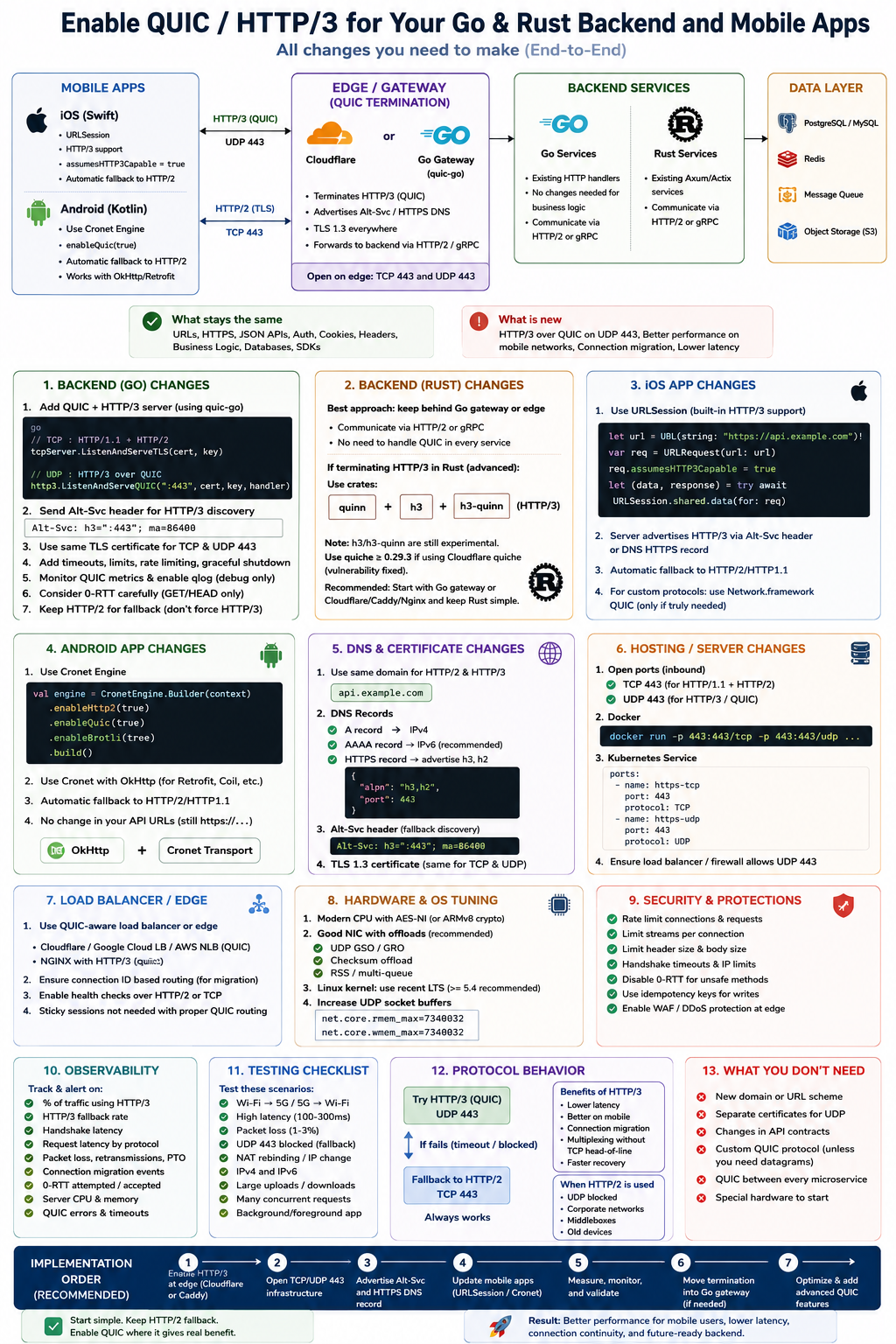
Upgrading an Existing Application to HTTP/3 over QUIC
The Final Verdict for Backend Engineers
If your infrastructure relies heavily on internal microservices running inside a secure, low-latency, zero-packet-loss local network or Kubernetes cluster, HTTP/2 over TCP/TLS (via gRPC or standard HTTP/2 pods) is incredibly efficient, battle-tested, and light on CPU resources.
However, if you are designing edge infrastructure, public-facing APIs, or handling unstable mobile clients, implementing HTTP/3 over QUIC at your edge proxy layer can reduce latency, eliminate reconnect lag, and provide a smoother experience across volatile networks. Just make sure your infrastructure monitoring teams are prepared for the UDP CPU tax!