Video coming soon. Start with the reading below.
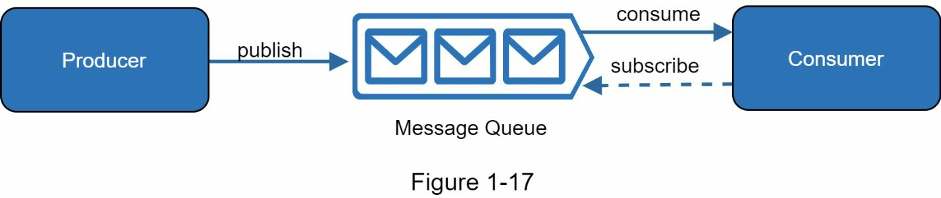
A message queue is a durable component, stored in memory, that supports asynchronous communication. It serves as a buffer and distributes asynchronous requests. The basic architecture of a message queue is simple. Input services, called producers/publishers, create messages, and publish them to a message queue. Other services or servers, called consumers/subscribers, connect to the queue, and perform actions defined by the messages. The model is shown in Figure 1-17.
Decoupling makes the message queue a preferred architecture for building a scalable and reliable application. With the message queue, the producer can post a message to the queue when the consumer is unavailable to process it. The consumer can read messages from the queue even when the producer is unavailable.
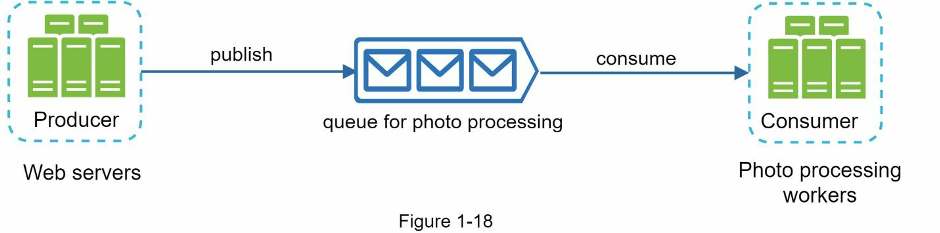
Consider the following use case: your application supports photo customization, including cropping, sharpening, blurring, etc. Those customization tasks take time to complete. In Figure 1-18, web servers publish photo processing jobs to the message queue. Photo processing workers pick up jobs from the message queue and asynchronously perform photo customization tasks. The producer and the consumer can be scaled independently. When the size of the queue becomes large, more workers are added to reduce the processing time. However, if the queue is empty most of the time, the number of workers can be reduced.