Video coming soon. Start with the reading below.
For large applications, it is infeasible to fit the complete data set in a single server. The simplest way to accomplish this is to split the data into smaller partitions and store them in multiple servers. There are two challenges while partitioning the data:
- Distribute data across multiple servers evenly.
- Minimize data movement when nodes are added or removed.
Consistent hashing discussed in Chapter 5 is a great technique to solve these problems. Let us revisit how consistent hashing works at a high-level.
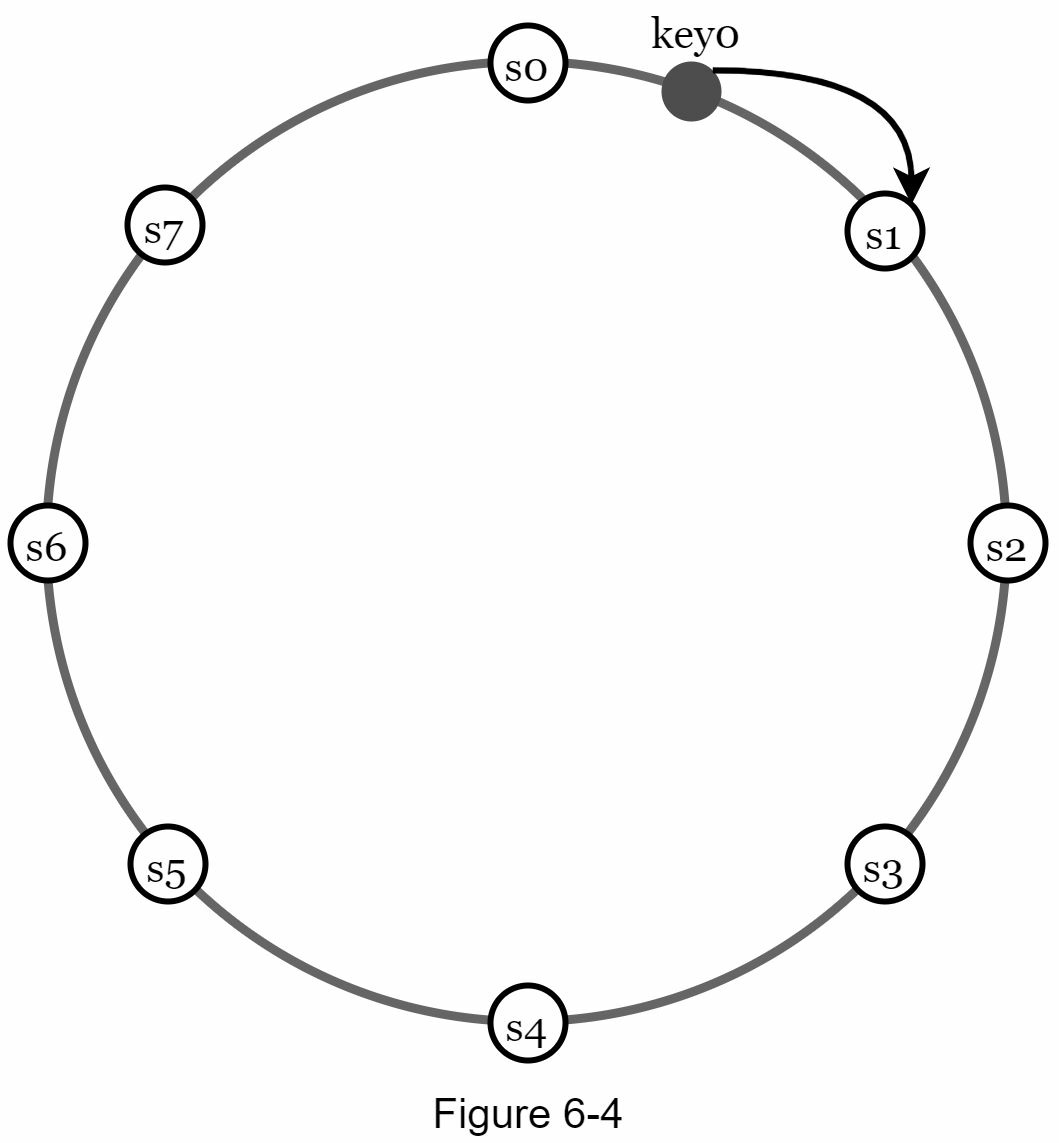
- First, servers are placed on a hash ring. In Figure 6-4, eight servers, represented by s0, s1, ..., s7, are placed on the hash ring.
- Next, a key is hashed onto the same ring, and it is stored on the first server encountered while moving in the clockwise direction. For instance, key0 is stored in s1 using this logic.
Using consistent hashing to partition data has the following advantages:
Automatic scaling: servers could be added and removed automatically depending on the load.
Heterogeneity: the number of virtual nodes for a server is proportional to the server capacity. For example, servers with higher capacity are assigned with more virtual nodes.