SECTION VIDEOQuery service
COMING SOONVideo coming soon. Start with the reading below.
In the high-level design, query service calls the database directly to fetch the top 5 results. Figure 13-11 shows the improved design as previous design is inefficient.
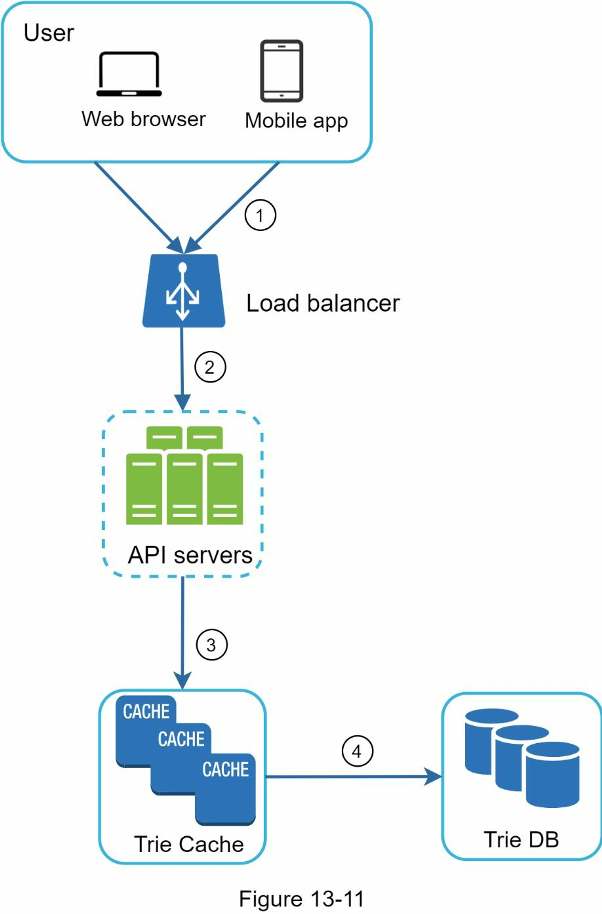
- A search query is sent to the load balancer.
- The load balancer routes the request to API servers.
- API servers get trie data from Trie Cache and construct autocomplete suggestions for the client.
- In case the data is not in Trie Cache, we replenish data back to the cache. This way, all subsequent requests for the same prefix are returned from the cache. A cache miss can happen when a cache server is out of memory or offline.
Query service requires lightning-fast speed. We propose the following optimizations:
- AJAX request. For web applications, browsers usually send AJAX requests to fetch autocomplete results. The main benefit of AJAX is that sending/receiving a request/response does not refresh the whole web page.
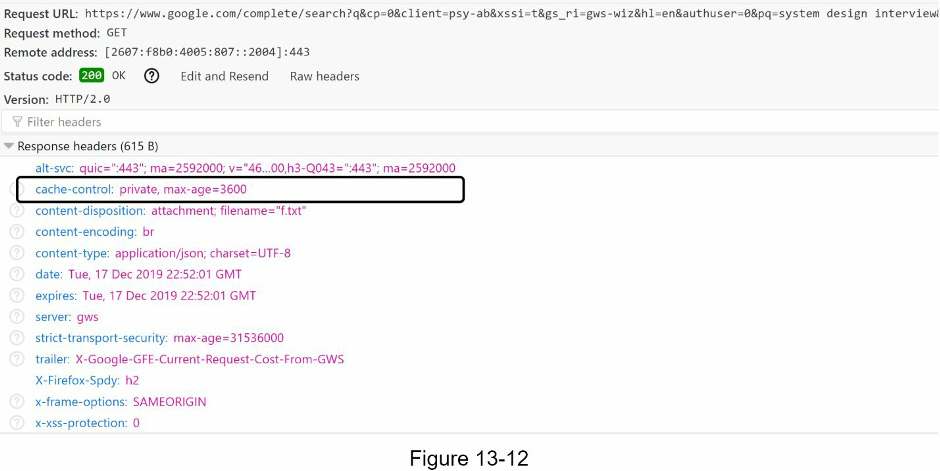
- Browser caching. For many applications, autocomplete search suggestions may not change much within a short time. Thus, autocomplete suggestions can be saved in browser cache to allow subsequent requests to get results from the cache directly. Google search engine uses the same cache mechanism. Figure 13-12 shows the response header when you type “system design interview” on the Google search engine. As you can see, Google
caches the results in the browser for 1 hour. Please note: “private” in cache-control means results are intended for a single user and must not be cached by a shared cache. “maxage=3600” means the cache is valid for 3600 seconds, aka, an hour.
- Data sampling: For a large-scale system, logging every search query requires a lot of processing power and storage. Data sampling is important. For instance, only 1 out of every N requests is logged by the system.
Progress is saved on this device.