Video coming soon. Start with the reading below.
Transcoding a video is computationally expensive and time-consuming. Besides, different content creators may have different video processing requirements. For instance, some content creators require watermarks on top of their videos, some provide thumbnail images themselves, and some upload high definition videos, whereas others do not.
To support different video processing pipelines and maintain high parallelism, it is important to add some level of abstraction and let client programmers define what tasks to execute. For example, Facebook’s streaming video engine uses a directed acyclic graph (DAG) programming model, which defines tasks in stages so they can be executed sequentially or parallelly [8]. In our design, we adopt a similar DAG model to achieve flexibility and parallelism. Figure 14-8 represents a DAG for video transcoding.
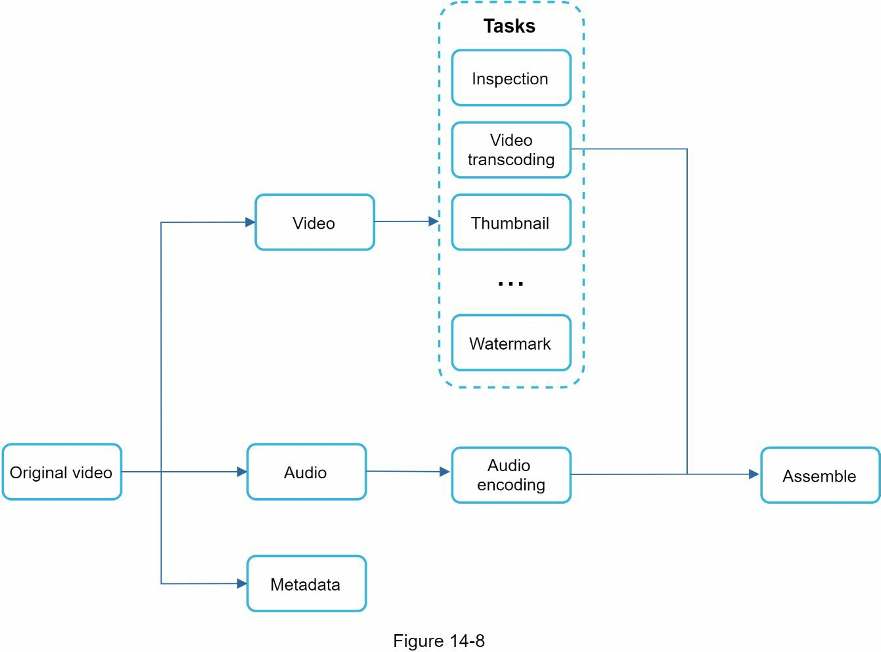
In Figure 14-8, the original video is split into video, audio, and metadata. Here are some of the tasks that can be applied on a video file:
- Inspection: Make sure videos have good quality and are not malformed.
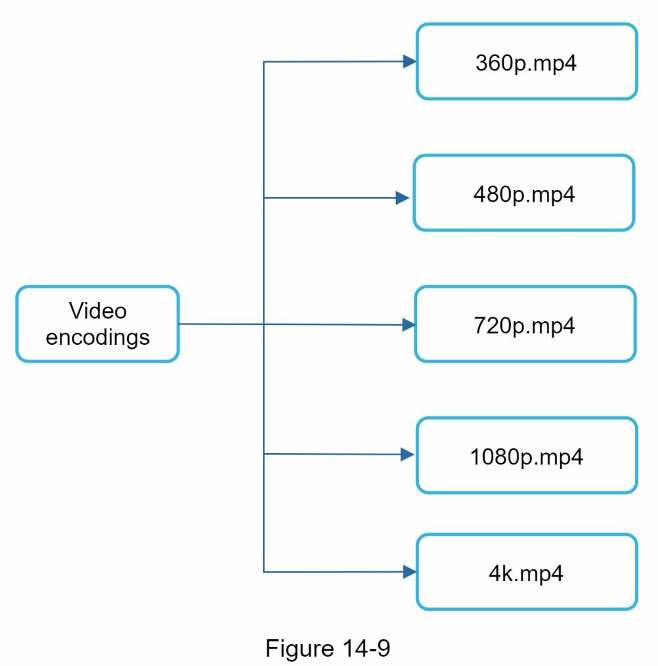
- Video encodings: Videos are converted to support different resolutions, codec, bitrates, etc. Figure 14-9 shows an example of video encoded files.
- Thumbnail. Thumbnails can either be uploaded by a user or automatically generated by the system.
- Watermark: An image overlay on top of your video contains identifying information about your video.