Video coming soon. Start with the reading below.
Hash function is used to hash a long URL to a short URL, also known as hashValue.
Hash value length The hashValue consists of characters from [0-9, a-z, A-Z], containing 10 + 26 + 26 = 62 possible characters. To figure out the length of hashValue, find the smallest n such that 62^n ≥ 365 billion. The system must support up to 365 billion URLs based on the back of the envelope estimation. Table 8-1 shows the length of hashValue and the corresponding maximal number of URLs it can support.
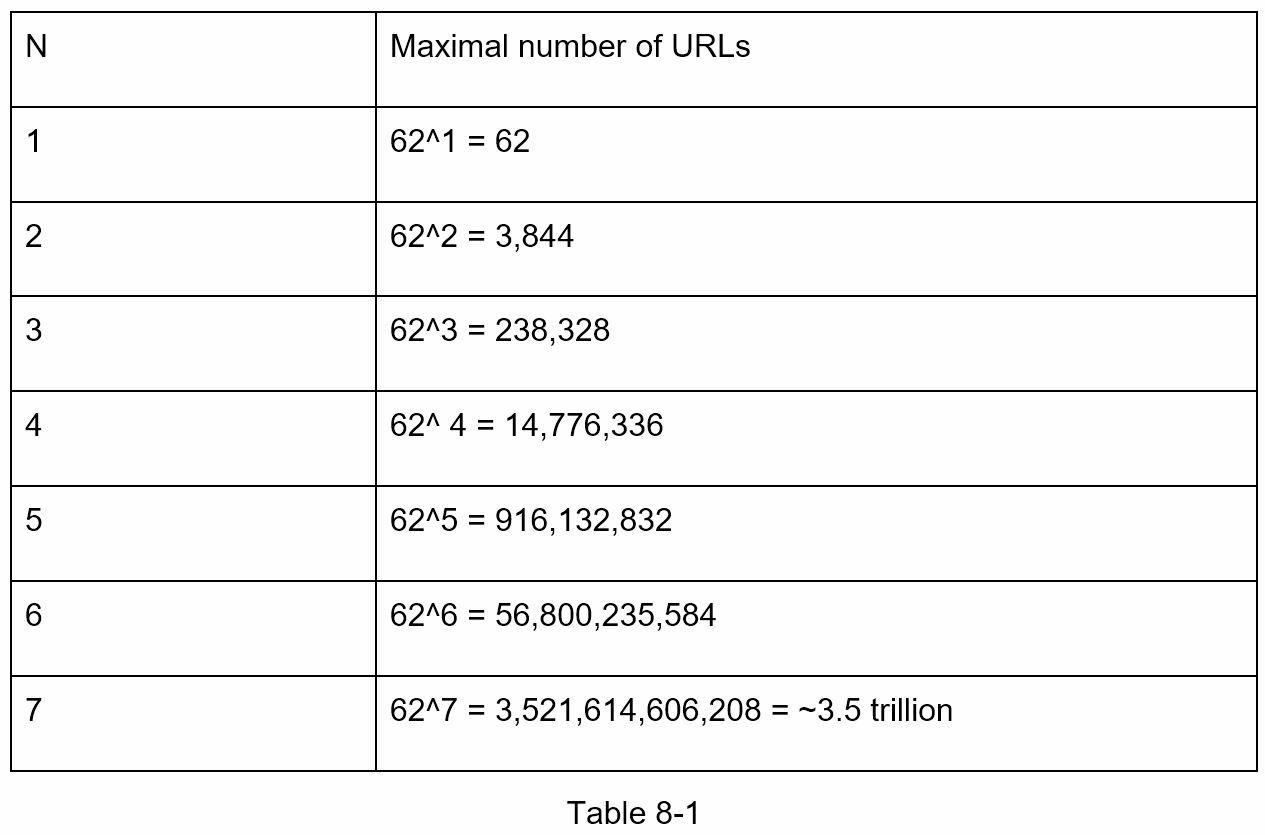
When n = 7, 62 ^ n = ~3.5 trillion, 3.5 trillion is more than enough to hold 365 billion URLs, so the length of hashValue is 7.
We will explore two types of hash functions for a URL shortener. The first one is “hash + collision resolution”, and the second one is “base 62 conversion.” Let us look at them one by one.
Hash + collision resolution To shorten a long URL, we should implement a hash function that hashes a long URL to a 7character string. A straightforward solution is to use well-known hash functions like CRC32, MD5, or SHA-1. The following table compares the hash results after applying different hash functions on this URL: https://en.wikipedia.org/wiki/Systems_design.
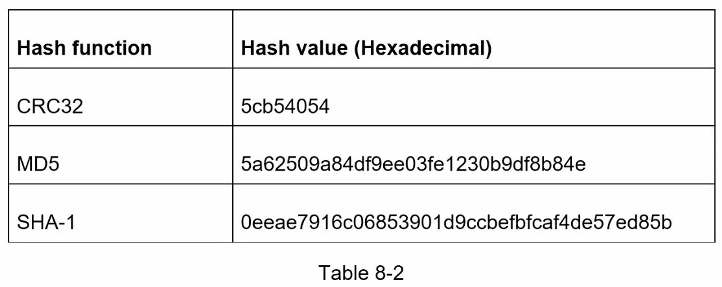
As shown in Table 8-2, even the shortest hash value (from CRC32) is too long (more than 7 characters). How can we make it shorter?
The first approach is to collect the first 7 characters of a hash value; however, this method can lead to hash collisions. To resolve hash collisions, we can recursively append a new predefined string until no more collision is discovered. This process is explained in Figure 8-
5.
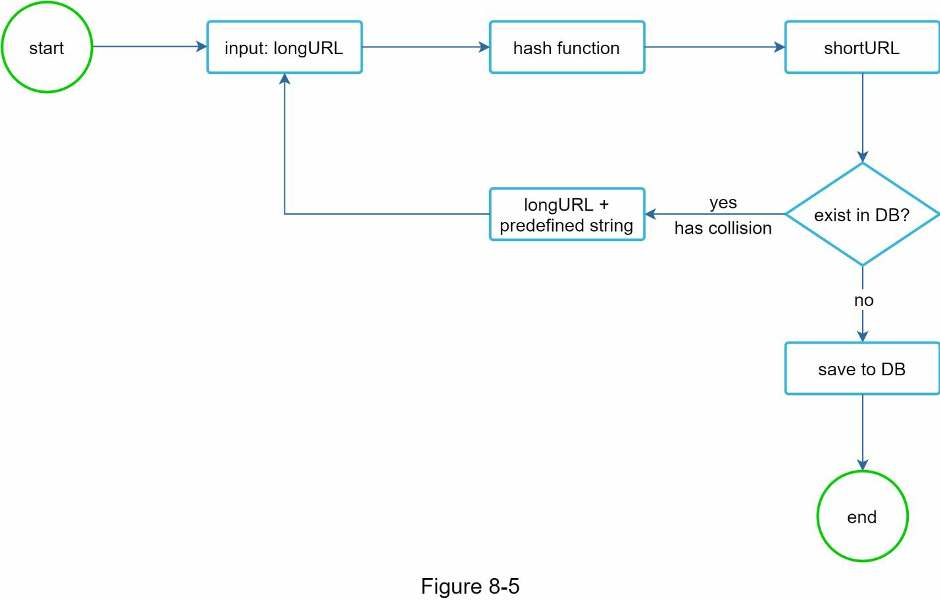
This method can eliminate collision; however, it is expensive to query the database to check if a shortURL exists for every request. A technique called bloom filters [2] can improve performance. A bloom filter is a space-efficient probabilistic technique to test if an element is a member of a set. Refer to the reference material [2] for more details.
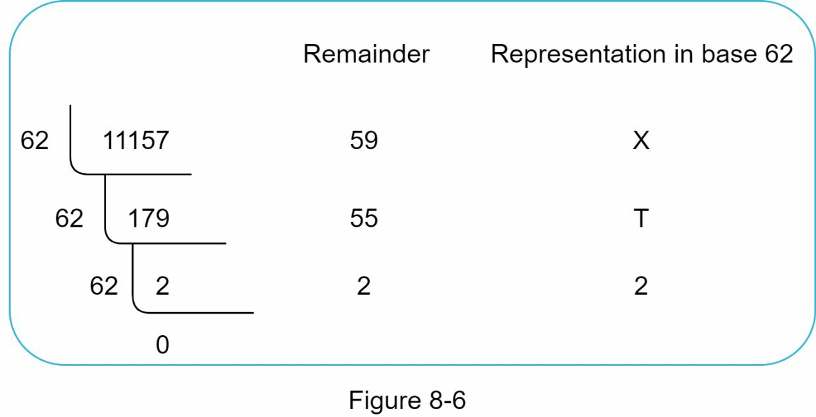
Base 62 conversion Base conversion is another approach commonly used for URL shorteners. Base conversion helps to convert the same number between its different number representation systems. Base 62 conversion is used as there are 62 possible characters for hashValue. Let us use an example to explain how the conversion works: convert 1115710 to base 62 representation
(1115710 represents 11157 in a base 10 system).
- From its name, base 62 is a way of using 62 characters for encoding. The mappings are: 0-0, ..., 9-9, 10-a, 11-b, ..., 35-z, 36-A, ..., 61-Z, where ‘a’ stands for 10, ‘Z’ stands for 61, etc.
- 1115710 = 2 x 622 + 55 x 621 + 59 x 620 = [2, 55, 59] -> [2, T, X] in base 62
representation. Figure 8-6 shows the conversation process.
- Thus, the short URL is https://tinyurl.com /2TX
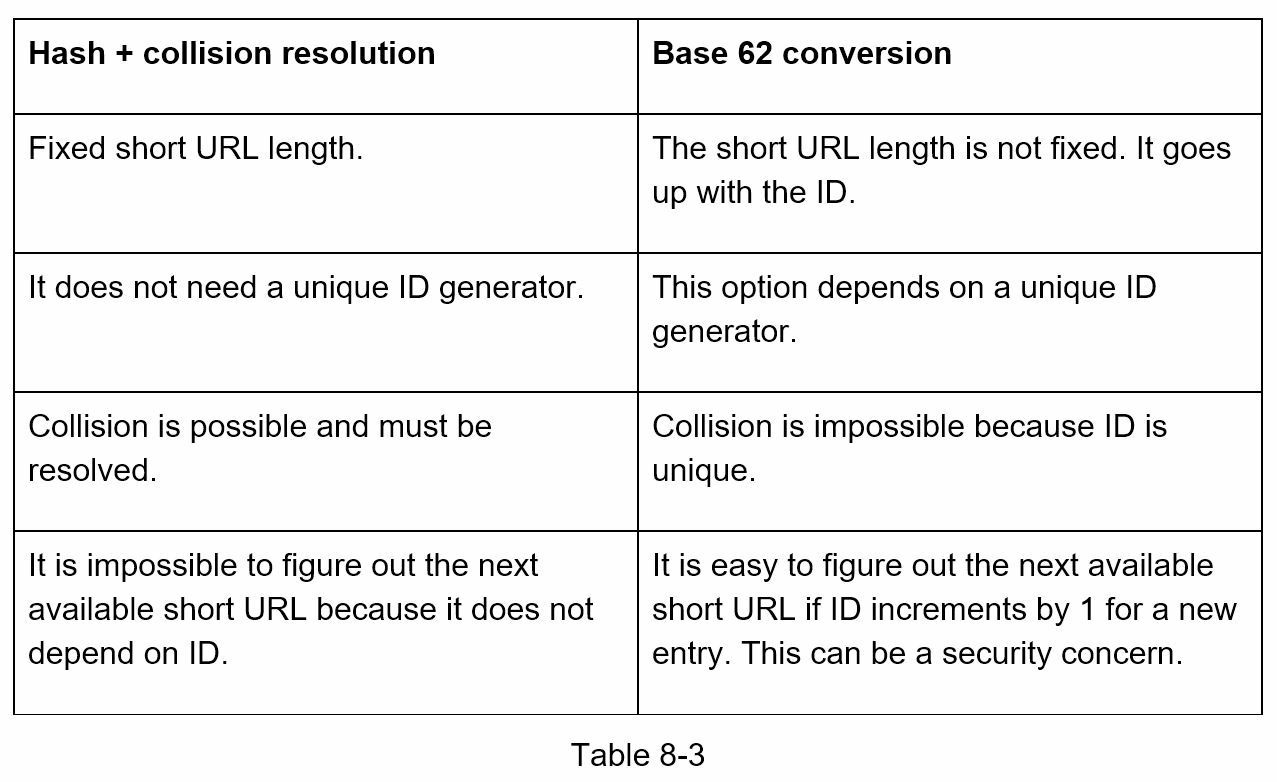
Comparison of the two approaches Table 8-3 shows the differences of the two approaches.