Video coming soon. Start with the reading below.
The consistent hashing algorithm was introduced by Karger et al. at MIT [1]. The basic steps are:
- Map servers and keys on to the ring using a uniformly distributed hash function.
- To find out which server a key is mapped to, go clockwise from the key position until the first server on the ring is found.
Two problems are identified with this approach. First, it is impossible to keep the same size of partitions on the ring for all servers considering a server can be added or removed. A partition is the hash space between adjacent servers. It is possible that the size of the partitions on the ring assigned to each server is very small or fairly large. In Figure 5-10, if s1 is removed, s2’s partition (highlighted with the bidirectional arrows) is twice as large as s0 and s3’s partition.
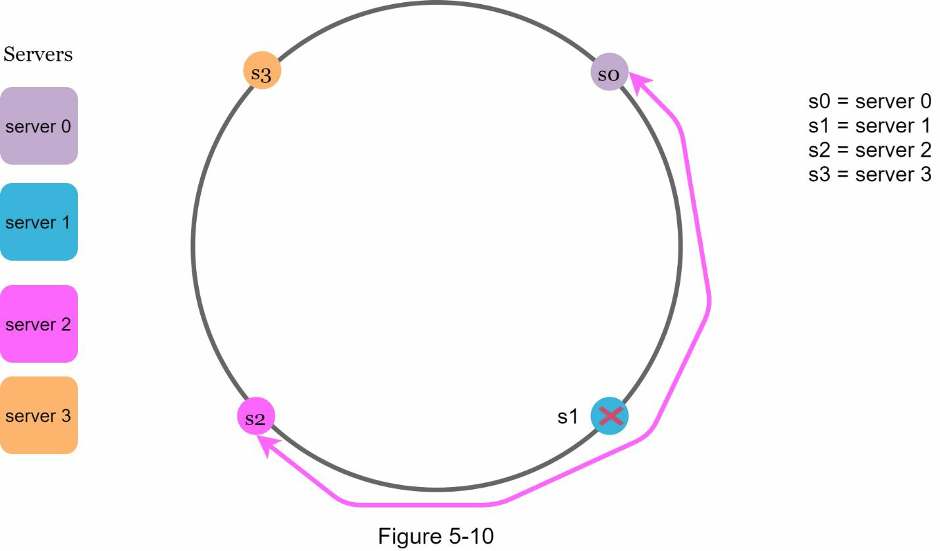
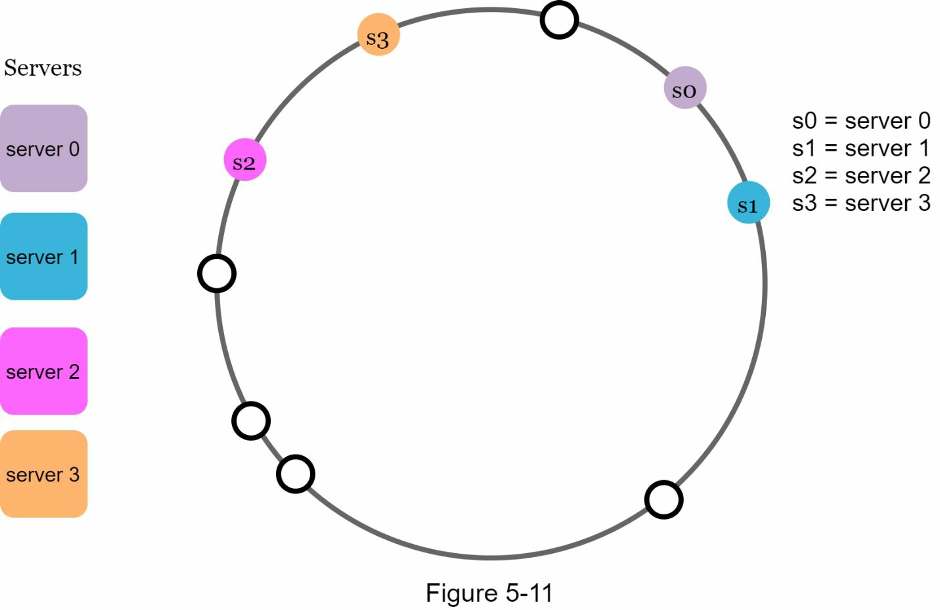
Second, it is possible to have a non-uniform key distribution on the ring. For instance, if servers are mapped to positions listed in Figure 5-11, most of the keys are stored on server 2. However, server 1 and server 3 have no data.
A technique called virtual nodes or replicas is used to solve these problems.