Video coming soon. Start with the reading below.
Relational databases are used for storage in the high-level design. However, fetching the top 5 search queries from a relational database is inefficient. The data structure trie (prefix tree) is used to overcome the problem. As trie data structure is crucial for the system, we will dedicate significant time to design a customized trie. Please note that some of the ideas are from articles [2] and [3].
Understanding the basic trie data structure is essential for this interview question. However, this is more of a data structure question than a system design question. Besides, many online materials explain this concept. In this chapter, we will only discuss an overview of the trie data structure and focus on how to optimize the basic trie to improve response time.
Trie (pronounced “try”) is a tree-like data structure that can compactly store strings. The name comes from the word retrieval, which indicates it is designed for string retrieval operations. The main idea of trie consists of the following:
- A trie is a tree-like data structure.
- The root represents an empty string.
- Each node stores a character and has 26 children, one for each possible character. To save space, we do not draw empty links.
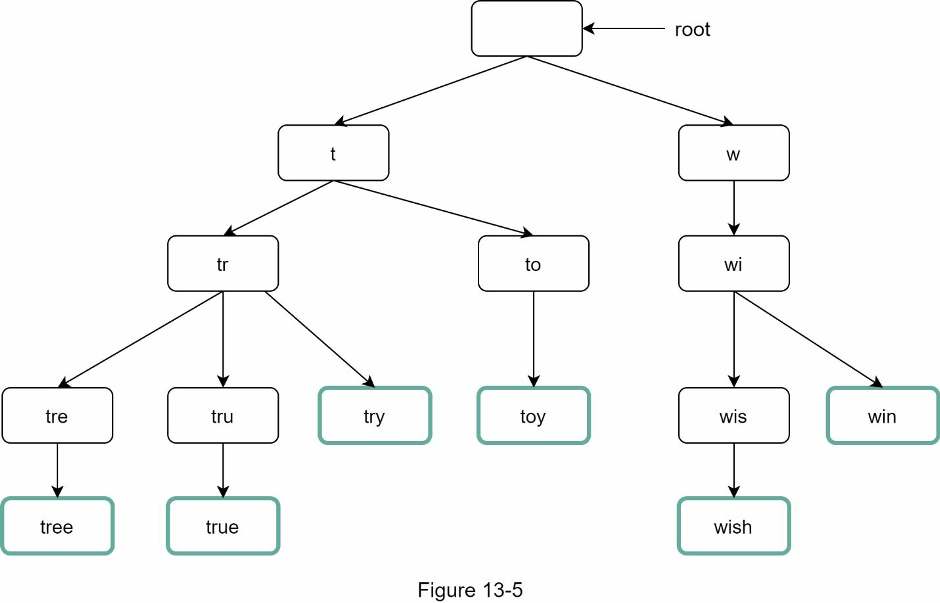
- Each tree node represents a single word or a prefix string. Figure 13-5 shows a trie with search queries “tree”, “try”, “true”, “toy”, “wish”, “win”. Search queries are highlighted with a thicker border.
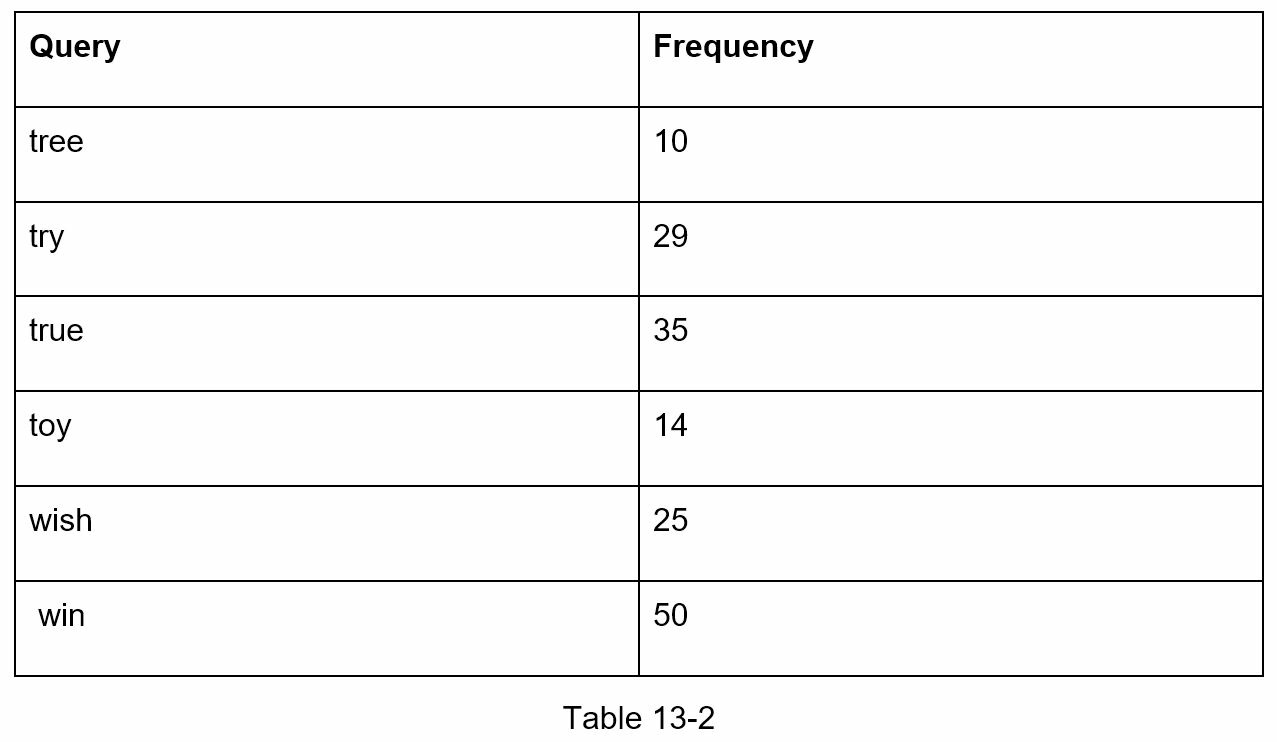
Basic trie data structure stores characters in nodes. To support sorting by frequency, frequency info needs to be included in nodes. Assume we have the following frequency table.
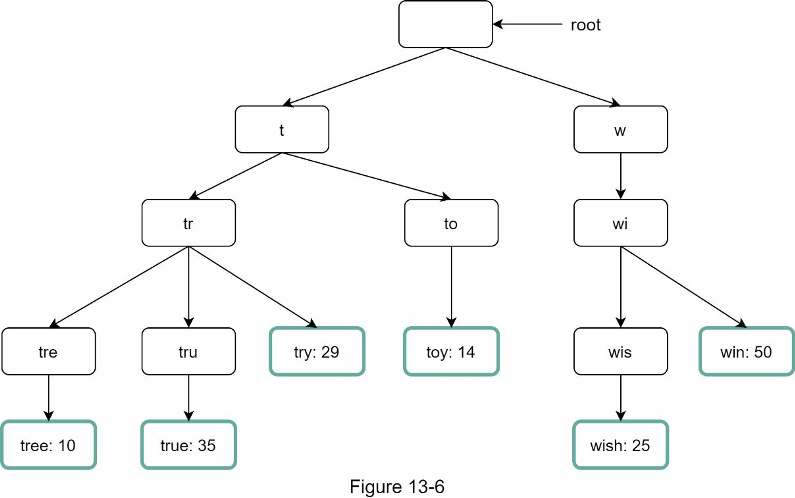
After adding frequency info to nodes, updated trie data structure is shown in Figure 13-6.
How does autocomplete work with trie? Before diving into the algorithm, let us define some terms.
- p: length of a prefix
- n: total number of nodes in a trie
- c: number of children of a given node
Steps to get top k most searched queries are listed below:
- Find the prefix. Time complexity: O(p).
- Traverse the subtree from the prefix node to get all valid children. A child is valid if it can form a valid query string. Time complexity: O(c)
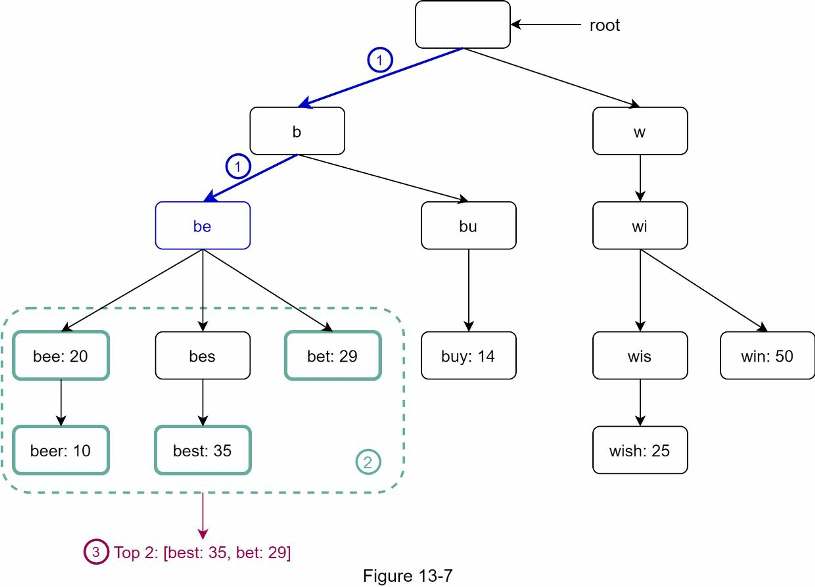
- Sort the children and get top k. Time complexity: O(clogc) Let us use an example as shown in Figure 13-7 to explain the algorithm. Assume k equals to 2 and a user types “tr” in the search box. The algorithm works as follows: • Step 1: Find the prefix node “tr”. • Step 2: Traverse the subtree to get all valid children. In this case, nodes [tree: 10], [true: 35], [try: 29] are valid. • Step 3: Sort the children and get top 2. [true: 35] and [try: 29] are the top 2 queries with prefix “tr”.
The time complexity of this algorithm is the sum of time spent on each step mentioned above: O(p) + O(c) + O(clogc)
The above algorithm is straightforward. However, it is too slow because we need to traverse the entire trie to get top k results in the worst-case scenario. Below are two optimizations:
- Limit the max length of a prefix
- Cache top search queries at each node Let us look at these optimizations one by one.
Limit the max length of a prefix Users rarely type a long search query into the search box. Thus, it is safe to say p is a small integer number, say 50. If we limit the length of a prefix, the time complexity for “Find the prefix” can be reduced from O(p) to O(small constant), aka O(1).
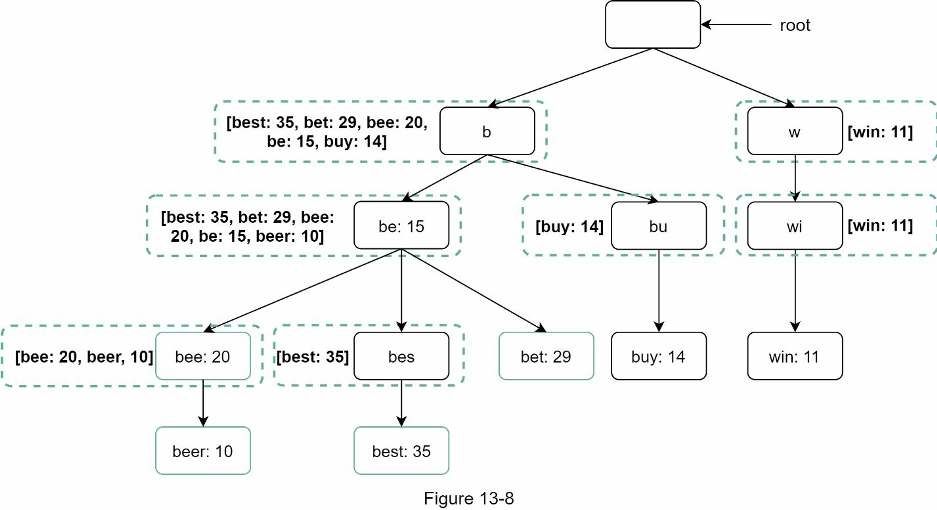
Cache top search queries at each node To avoid traversing the whole trie, we store top k most frequently used queries at each node. Since 5 to 10 autocomplete suggestions are enough for users, k is a relatively small number. In our specific case, only the top 5 search queries are cached.
By caching top search queries at every node, we significantly reduce the time complexity to retrieve the top 5 queries. However, this design requires a lot of space to store top queries at every node. Trading space for time is well worth it as fast response time is very important.
Figure 13-8 shows the updated trie data structure. Top 5 queries are stored on each node. For example, the node with prefix “be” stores the following: [best: 35, bet: 29, bee: 20, be: 15, beer: 10].
Let us revisit the time complexity of the algorithm after applying those two optimizations:
- Find the prefix node. Time complexity: O(1)
- Return top k. Since top k queries are cached, the time complexity for this step is O(1). As the time complexity for each of the steps is reduced to O(1), our algorithm takes only O(1) to fetch top k queries.