Video coming soon. Start with the reading below.
At this step, you and your interviewer should have already achieved the following objectives:
- Agreed on the overall goals and feature scope
- Sketched out a high-level blueprint for the overall design
- Obtained feedback from your interviewer on the high-level design
- Had some initial ideas about areas to focus on in deep dive based on her feedback
You shall work with the interviewer to identify and prioritize components in the architecture. It is worth stressing that every interview is different. Sometimes, the interviewer may give off hints that she likes focusing on high-level design. Sometimes, for a senior candidate interview, the discussion could be on the system performance characteristics, likely focusing on the bottlenecks and resource estimations. In most cases, the interviewer may want you to dig into details of some system components. For URL shortener, it is interesting to dive into the hash function design that converts a long URL to a short one. For a chat system, how to reduce latency and how to support online/offline status are two interesting topics.
Time management is essential as it is easy to get carried away with minute details that do not demonstrate your abilities. You must be armed with signals to show your interviewer. Try not to get into unnecessary details. For example, talking about the EdgeRank algorithm of Facebook feed ranking in detail is not ideal during a system design interview as this takes much precious time and does not prove your ability in designing a scalable system.
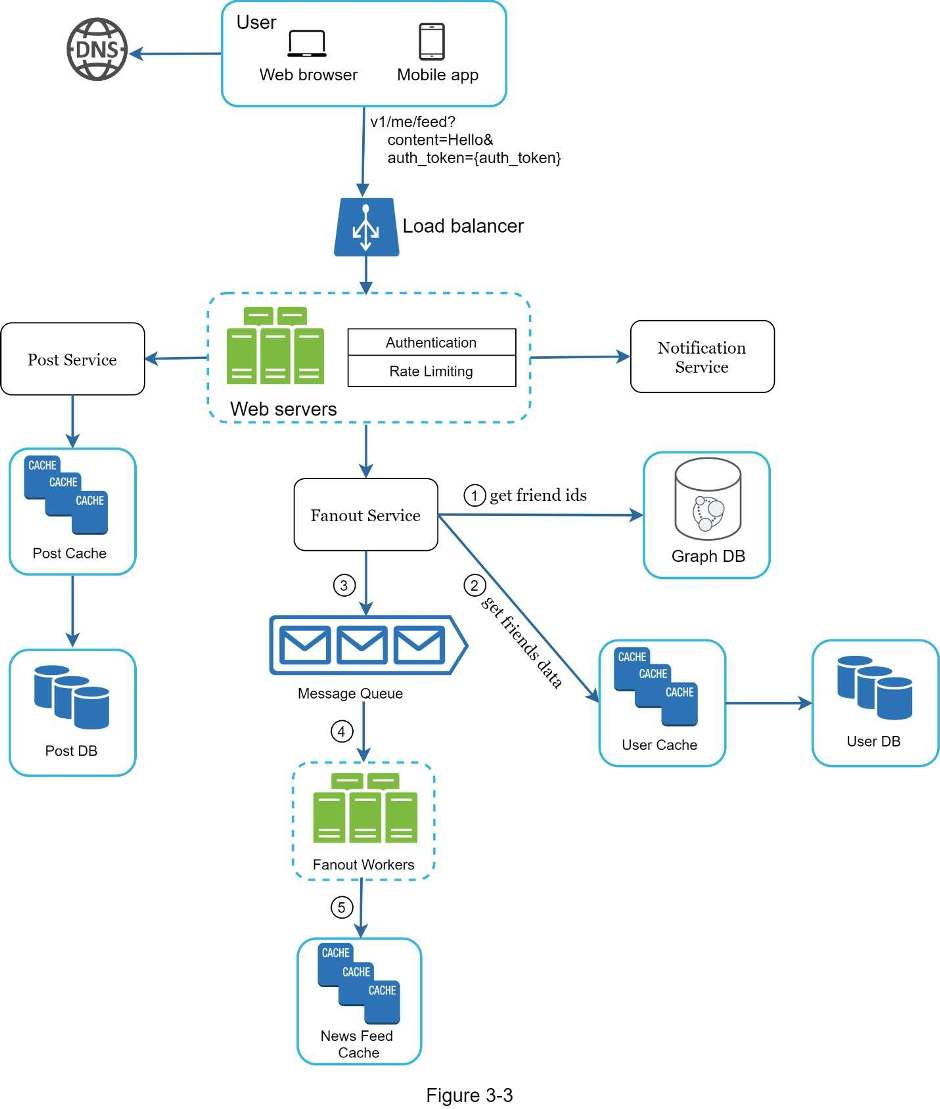
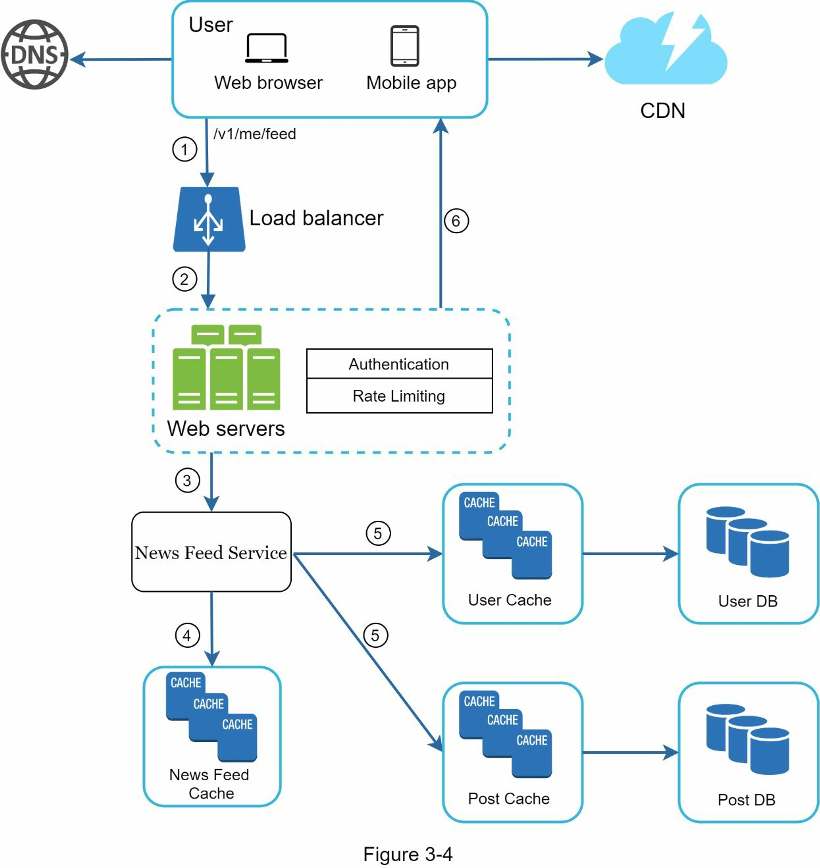
Example At this point, we have discussed the high-level design for a news feed system, and the interviewer is happy with your proposal. Next, we will investigate two of the most important use cases:
- Feed publishing
- News feed retrieval
Figure 3-3 and Figure 3-4 show the detailed design for the two use cases, which will be explained in detail in Chapter 11.