Video coming soon. Start with the reading below.
In this step, we aim to develop a high-level design and reach an agreement with the interviewer on the design. It is a great idea to collaborate with the interviewer during the process.
- Come up with an initial blueprint for the design. Ask for feedback. Treat your interviewer as a teammate and work together. Many good interviewers love to talk and get involved.
- Draw box diagrams with key components on the whiteboard or paper. This might include clients (mobile/web), APIs, web servers, data stores, cache, CDN, message queue, etc.
- Do back-of-the-envelope calculations to evaluate if your blueprint fits the scale constraints. Think out loud. Communicate with your interviewer if back-of-the-envelope is necessary before diving into it.
If possible, go through a few concrete use cases. This will help you frame the high-level design. It is also likely that the use cases would help you discover edge cases you have not yet considered.
Should we include API endpoints and database schema here? This depends on the problem. For large design problems like “Design Google search engine”, this is a bit of too low level. For a problem like designing the backend for a multi-player poker game, this is a fair game. Communicate with your interviewer.
Example Let us use “Design a news feed system” to demonstrate how to approach the high-level design. Here you are not required to understand how the system actually works. All the details will be explained in Chapter 11.
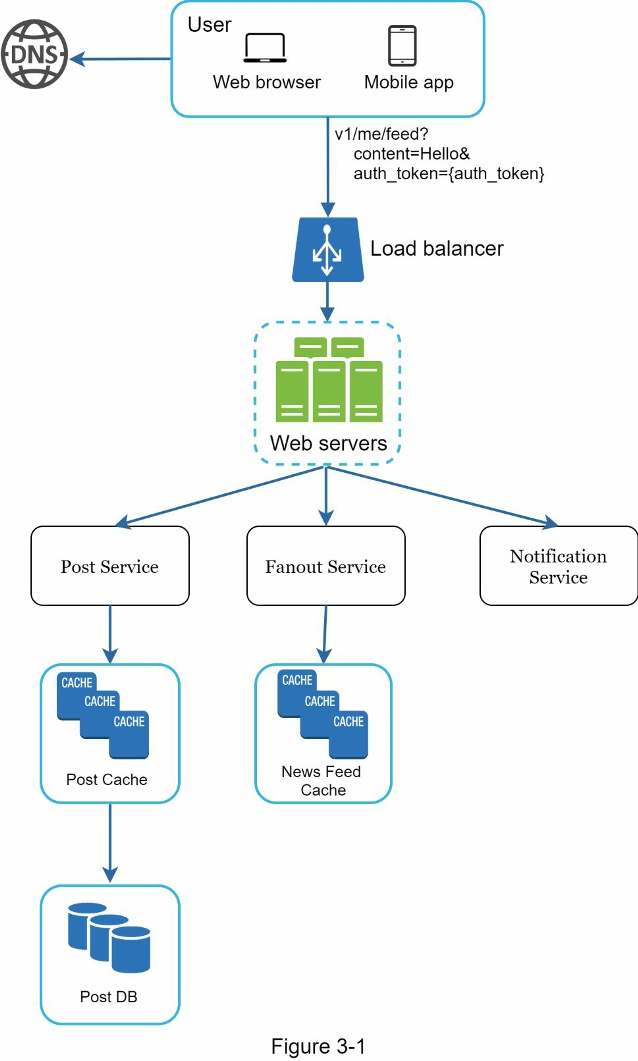
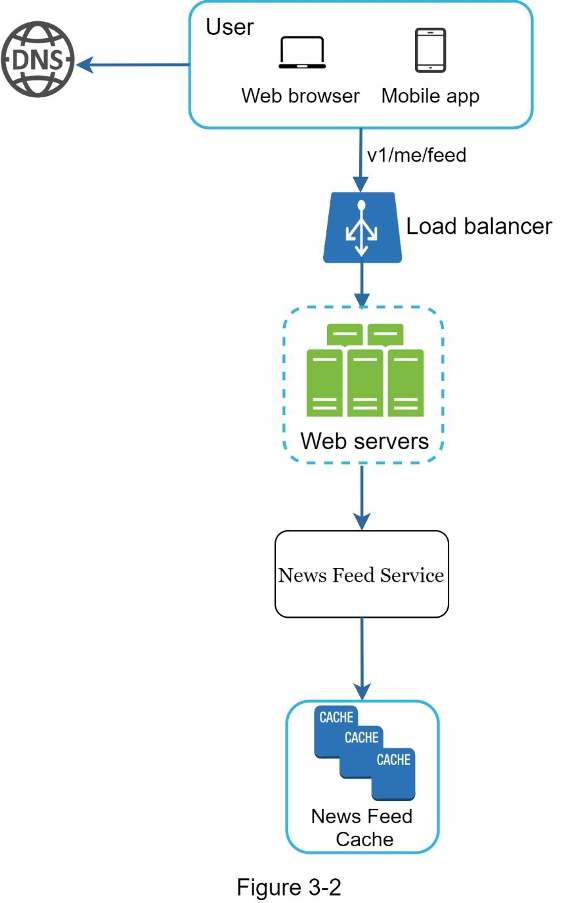
At the high level, the design is divided into two flows: feed publishing and news feed building.
- Feed publishing: when a user publishes a post, corresponding data is written into cache/database, and the post will be populated into friends’ news feed.
- Newsfeed building: the news feed is built by aggregating friends’ posts in a reverse chronological order.
Figure 3-1 and Figure 3-2 present high-level designs for feed publishing and news feed building flows, respectively.