Video coming soon. Start with the reading below.
To develop a high-quality design, we should have a basic knowledge of how clients and servers communicate. In a chat system, clients can be either mobile applications or web applications. Clients do not communicate directly with each other. Instead, each client connects to a chat service, which supports all the features mentioned above. Let us focus on fundamental operations. The chat service must support the following functions:
- Receive messages from other clients.
- Find the right recipients for each message and relay the message to the recipients.
- If a recipient is not online, hold the messages for that recipient on the server until she is online.
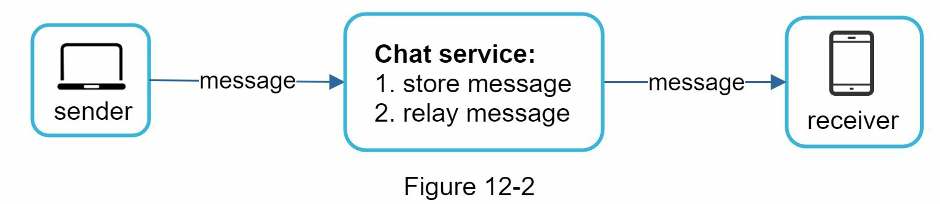
Figure 12-2 shows the relationships between clients (sender and receiver) and the chat service.
When a client intends to start a chat, it connects the chats service using one or more network protocols. For a chat service, the choice of network protocols is important. Let us discuss this with the interviewer.
Requests are initiated by the client for most client/server applications. This is also true for the sender side of a chat application. In Figure 12-2, when the sender sends a message to the receiver via the chat service, it uses the time-tested HTTP protocol, which is the most common web protocol. In this scenario, the client opens a HTTP connection with the chat service and sends the message, informing the service to send the message to the receiver. The keep-alive is efficient for this because the keep-alive header allows a client to maintain a persistent connection with the chat service. It also reduces the number of TCP handshakes. HTTP is a fine option on the sender side, and many popular chat applications such as Facebook [1] used HTTP initially to send messages.
However, the receiver side is a bit more complicated. Since HTTP is client-initiated, it is not trivial to send messages from the server. Over the years, many techniques are used to simulate a server-initiated connection: polling, long polling, and WebSocket. Those are important techniques widely used in system design interviews so let us examine each of them.