Video coming soon. Start with the reading below.
Now that we have developed a system to bring autocomplete queries to users, it is time to solve the scalability issue when the trie grows too large to fit in one server.
Since English is the only supported language, a naive way to shard is based on the first character. Here are some examples.
- If we need two servers for storage, we can store queries starting with ‘a’ to ‘m’ on the first server, and ‘n’ to ‘z’ on the second server.
- If we need three servers, we can split queries into ‘a’ to ‘i’, ‘j’ to ‘r’ and ‘s’ to ‘z’.
Following this logic, we can split queries up to 26 servers because there are 26 alphabetic characters in English. Let us define sharding based on the first character as first level sharding. To store data beyond 26 servers, we can shard on the second or even at the third level. For example, data queries that start with ‘a’ can be split into 4 servers: ‘aa-ag’, ‘ahan’, ‘ao-au’, and ‘av-az’.
At the first glance this approach seems reasonable, until you realize that there are a lot more words that start with the letter ‘c’ than ‘x’. This creates uneven distribution.
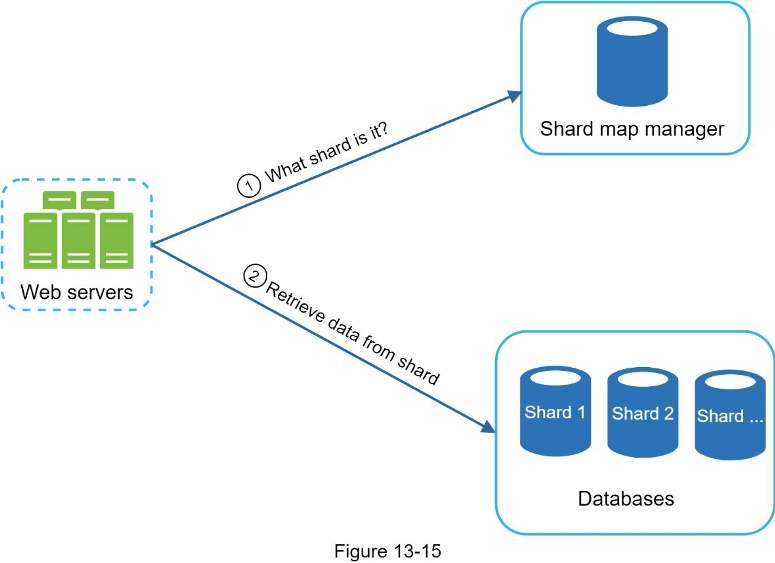
To mitigate the data imbalance problem, we analyze historical data distribution pattern and apply smarter sharding logic as shown in Figure 13-15. The shard map manager maintains a lookup database for identifying where rows should be stored. For example, if there are a similar number of historical queries for ‘s’ and for ‘u’, ‘v’, ‘w’, ‘x’, ‘y’ and ‘z’ combined, we can maintain two shards: one for ‘s’ and one for ‘u’ to ‘z’.