Video coming soon. Start with the reading below.
Just now we mentioned that WebSocket was chosen as the main communication protocol between the client and server for its bidirectional communication, it is important to note that everything else does not have to be WebSocket. In fact, most features (sign up, login, user profile, etc) of a chat application could use the traditional request/response method over HTTP. Let us drill in a bit and look at the high-level components of the system.
As shown in Figure 12-7, the chat system is broken down into three major categories: stateless services, stateful services, and third-party integration.
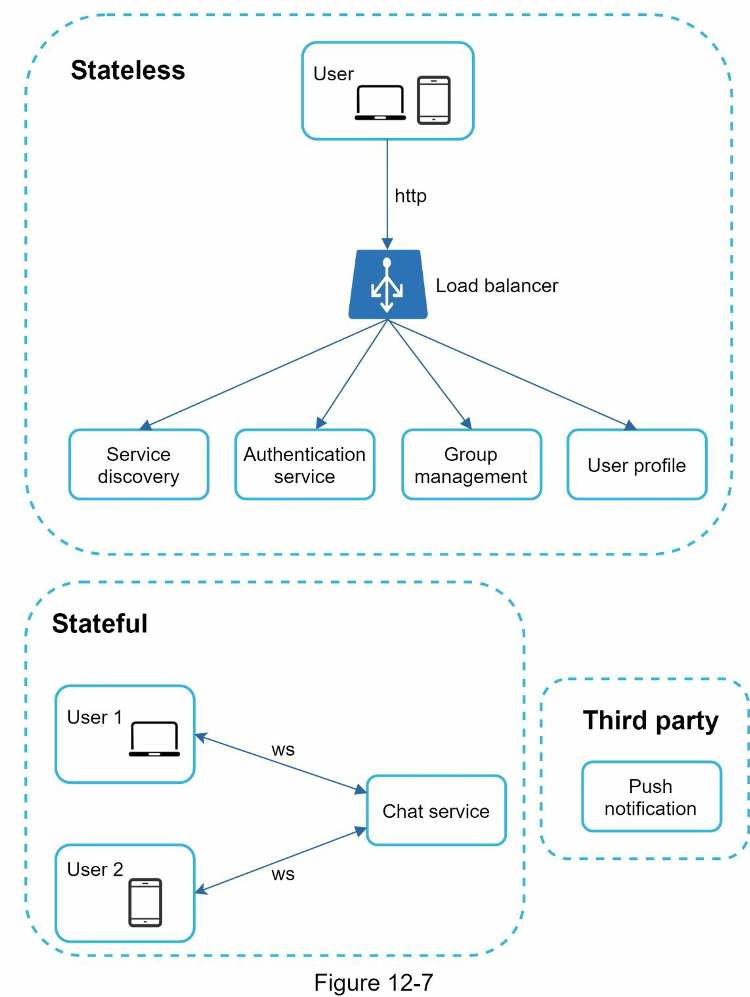
Stateless Services Stateless services are traditional public-facing request/response services, used to manage the login, signup, user profile, etc. These are common features among many websites and apps.
Stateless services sit behind a load balancer whose job is to route requests to the correct services based on the request paths. These services can be monolithic or individual microservices. We do not need to build many of these stateless services by ourselves as there are services in the market that can be integrated easily. The one service that we will discuss more in deep dive is the service discovery. Its primary job is to give the client a list of DNS host names of chat servers that the client could connect to.
Stateful Service The only stateful service is the chat service. The service is stateful because each client maintains a persistent network connection to a chat server. In this service, a client normally does not switch to another chat server as long as the server is still available. The service discovery coordinates closely with the chat service to avoid server overloading. We will go into detail in deep dive.
Third-party integration For a chat app, push notification is the most important third-party integration. It is a way to inform users when new messages have arrived, even when the app is not running. Proper integration of push notification is crucial. Refer to Chapter 10 Design a notification system for more information.
Scalability On a small scale, all services listed above could fit in one server. Even at the scale we design for, it is in theory possible to fit all user connections in one modern cloud server. The number of concurrent connections that a server can handle will most likely be the limiting factor. In our scenario, at 1M concurrent users, assuming each user connection needs 10K of memory on the server (this is a very rough figure and very dependent on the language choice), it only needs about 10GB of memory to hold all the connections on one box.
If we propose a design where everything fits in one server, this may raise a big red flag in the interviewer’s mind. No technologist would design such a scale in a single server. Single server design is a deal breaker due to many factors. The single point of failure is the biggest among them.
However, it is perfectly fine to start with a single server design. Just make sure the interviewer knows this is a starting point. Putting everything we mentioned together, Figure 12-8 shows the adjusted high-level design.
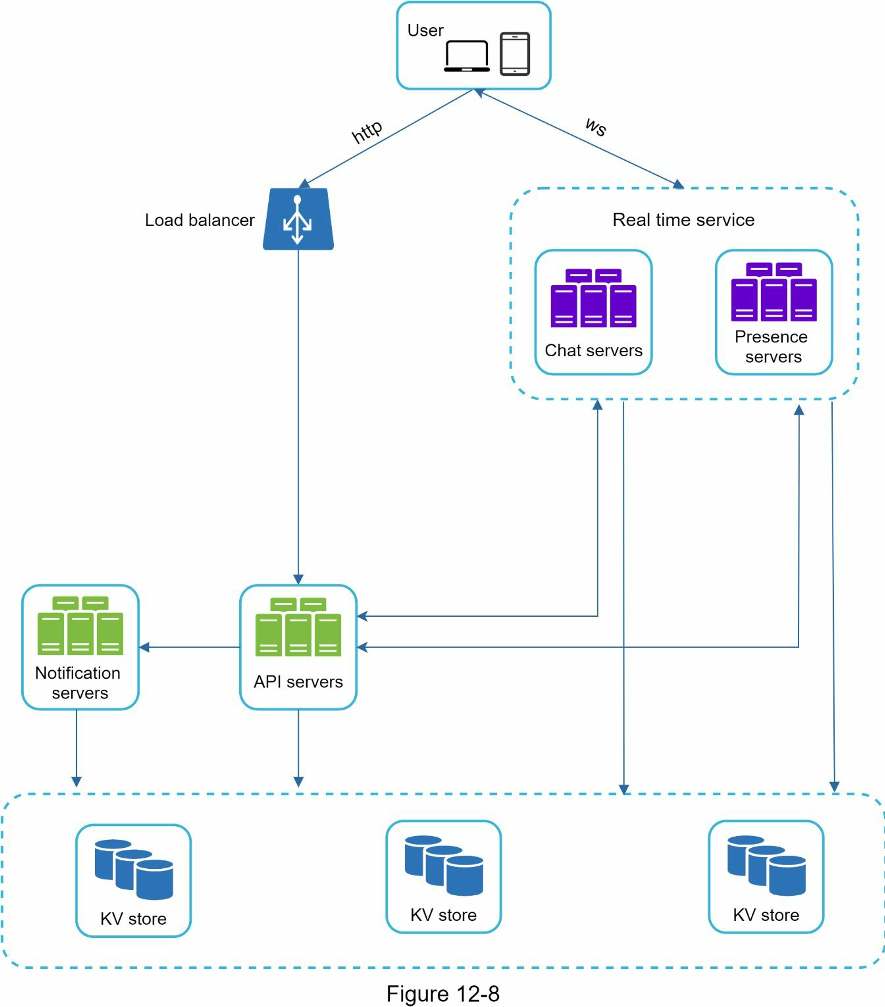
In Figure 12-8, the client maintains a persistent WebSocket connection to a chat server for real-time messaging.
- Chat servers facilitate message sending/receiving.
- Presence servers manage online/offline status.
- API servers handle everything including user login, signup, change profile, etc.
- Notification servers send push notifications.
- Finally, the key-value store is used to store chat history. When an offline user comes online, she will see all her previous chat history.
Storage At this point, we have servers ready, services up running and third-party integrations complete. Deep down the technical stack is the data layer. Data layer usually requires some effort to get it correct. An important decision we must make is to decide on the right type of database to use: relational databases or NoSQL databases? To make an informed decision, we will examine the data types and read/write patterns.
Two types of data exist in a typical chat system. The first is generic data, such as user profile, setting, user friends list. These data are stored in robust and reliable relational databases. Replication and sharding are common techniques to satisfy availability and scalability requirements.
The second is unique to chat systems: chat history data. It is important to understand the read/write pattern.
- The amount of data is enormous for chat systems. A previous study [2] reveals that Facebook messenger and Whatsapp process 60 billion messages a day.
- Only recent chats are accessed frequently. Users do not usually look up for old chats.
- Although very recent chat history is viewed in most cases, users might use features that require random access of data, such as search, view your mentions, jump to specific messages, etc. These cases should be supported by the data access layer.
- The read to write ratio is about 1:1 for 1 on 1 chat apps.
Selecting the correct storage system that supports all of our use cases is crucial. We recommend key-value stores for the following reasons:
- Key-value stores allow easy horizontal scaling.
- Key-value stores provide very low latency to access data.
- Relational databases do not handle long tail [3] of data well. When the indexes grow large, random access is expensive.
- Key-value stores are adopted by other proven reliable chat applications. For example, both Facebook messenger and Discord use key-value stores. Facebook messenger uses HBase [4], and Discord uses Cassandra [5].