Video coming soon. Start with the reading below.
Figure 15-10 illustrates the proposed high-level design. Let us examine each component of the system.
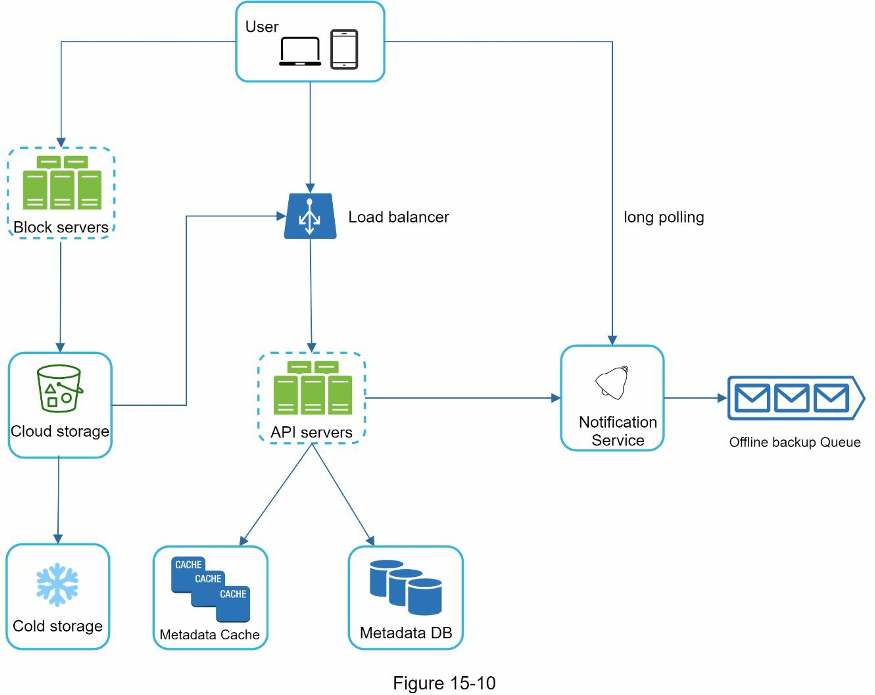
User: A user uses the application either through a browser or mobile app.
Block servers: Block servers upload blocks to cloud storage. Block storage, referred to as block-level storage, is a technology to store data files on cloud-based environments. A file can be split into several blocks, each with a unique hash value, stored in our metadata database. Each block is treated as an independent object and stored in our storage system (S3). To reconstruct a file, blocks are joined in a particular order. As for the block size, we use Dropbox as a reference: it sets the maximal size of a block to 4MB [6].
Cloud storage: A file is split into smaller blocks and stored in cloud storage.
Cold storage: Cold storage is a computer system designed for storing inactive data, meaning files are not accessed for a long time.
Load balancer: A load balancer evenly distributes requests among API servers.
API servers: These are responsible for almost everything other than the uploading flow. API servers are used for user authentication, managing user profile, updating file metadata, etc.
Metadata database: It stores metadata of users, files, blocks, versions, etc. Please note that files are stored in the cloud and the metadata database only contains metadata.
Metadata cache: Some of the metadata are cached for fast retrieval.
Notification service: It is a publisher/subscriber system that allows data to be transferred from notification service to clients as certain events happen. In our specific case, notification service notifies relevant clients when a file is added/edited/removed elsewhere so they can pull the latest changes.
Offline backup queue: If a client is offline and cannot pull the latest file changes, the offline backup queue stores the info so changes will be synced when the client is online.
We have discussed the design of Google Drive at the high-level. Some of the components are complicated and worth careful examination; we will discuss these in detail in the deep dive.